Draw Media
News / Kurdistan

How a Kurdish dream went up in smoke

Draw Media reportersonline/ by Judit Neurink Iraqi Kurds have had to give up the dream that oil would help them achieve independence. Citizens blame their leaders, who do not stop quarreling and enriching themselves. If a new political party were to emerge now in the Kurdish Region of Iraq, it would get more seats in parliament than either of the two current largest parties, while a quarter of voters would not vote at all. This result of a recent opinion poll is not surprising, considering the crumbling trust in the oldest Kurdish parties KDP and PUK. In the past, however, the rise of new parties has shown that they do not do what is expected of them either, namely, taking care of the citizens. Those interviewed for the pollsters must, therefore, be pretty desperate. The biggest problem for most parties can be found in their foundation: a family or person, and in the loyalty to them. But they are never based on a party program that focuses on the points citizens find important. Even new parties don’t have those – and in fact, there aren’t really any new parties at the moment. Those that once were, are usually counter-parties: opposition for opposition’s sake, without providing workable alternatives. What predominates in Kurdish politics is the use of fear for an enemy. Internally, the contrasts that have always existed are magnified, resulting in the KDP and PUK barely governing together anymore. But also externally, towards Baghdad, which is said to always want to cut the Kurds down to size. This is a popular instrument to get Kurds to rally behind their leader. Lack However, what the poll most of all shows is how fed-up the Kurds are with their leaders and politicians. This is mainly due to the lack of progress resulting from their policies. While taxes are rising (the Kurdish government needs money, it can barely pay its civil servants), just like the prices (under the pressure from the global market and the war in Ukraine), the government is providing fewer services. The hours when an (expensive) neighbourhood generator is needed to supplement government supplied electricity are increasing. While a water tanker is needed more often because there is no water coming from the tap for days on end. Protests are therefore increasing, with supporters of KDP and PUK also participating. Although new roads are being built (ring roads for Erbil, and a highway from Duhok to Erbil), many other roads go without maintenance. It makes the potholed road surface a danger to traffic. Villages are not being connected, no matter how often the dirt road turns into an impassable mud pool in winter. And no matter how often villagers plead for asphalt. Iraqi Kurds were promised that all problems would be solved once they started extracting and selling their own oil and gas. They would no longer depend on Baghdad. This has now been proven demonstrably wrong. The reasons are clear, although the politicians blame others. It is due to the power games of the KDP, and the resistance to it from a divided PUK. To self-enrichment and corruption. But above all, because of the unwillingness to cooperate with each other. Wrong Things went terribly wrong when the 2017 referendum on Kurdish independence upset both Baghdad and foreign allies and sponsors. Not only did Erbil lose its influence in the so-called Kurdistani areas (claimed by both Erbil and Baghdad). It also lost control over the oil city of Kirkuk. And that was just the beginning. Because in this way, Baghdad managed to increase its influence over the Kurdistan Region. And next, the Federal Supreme Court, the highest Iraqi court, got involved. And it ruled that the postponement of the Kurdish parliamentary elections at the end of last year had been illegal. A number of decisions taken since then is declared to be void, and the Kurdistan government has been given a caretaker status until a new parliament is elected. That delay last year was agreed upon only because KDP and PUK could not agree on adjustments to the electoral law. This even led to Deputy Prime Minister Qubad Talabani boycotting cabinet meetings for months. Only under American pressure and threats to withdraw their support for the Peshmerga forces of both parties, was this resolved. Turkey These conflicts also cloud the Kurdish relationship with Turkey – which is pursuing and bombing the Turkish-Kurdish PKK on the territory of the Kurdistan Region of Iraq. The PUK allows the PKK to operate in areas under its control, while the KDP does not obstruct Turkey’s attacks in the slightest. Baghdad plays its own role; it views the PKK as a foreign militia operating on Iraqi territory and wants to establish a military cordon around its main camp, Makhmour, only kilometers away from Erbil. Kurdish citizens despairingly shake their heads over all this, increasingly losing their faith in the problem-solving abilities of their administrators. Another interesting survey indicates that as many as eighty percent of Kurds believe it is to their advantage that the Kurdistan Region has lost its independent oil extraction to Baghdad. Only seventeen percent think otherwise. Because that is the latest big blow that the Kurds have had to absorb, which is again the result of all that internal strife. For years, they had insisted that according to the Iraqi constitution of 2005, the oil belongs to all Iraqis. That would give the Kurdistan government the right to sign contracts with oil companies and export oil without involving Baghdad. In February, the Federal Supreme Court once again ruled that this Kurdish policy was against the constitution. A month later Baghdad won an arbitration case against Turkey, thus preventing it from exporting Kurdish oil without Baghdad’s intervention. Halt All oil exports came to a halt – and remain so, which means a loss of billions of dollars in revenue. This forced Erbil and Baghdad to reach an agreement, where the Kurds had to give up their independence on this issue as well. The 400,000 barrels that Kurdistan produces daily are transferred to the Iraqi state company SOMO, which deposits its revenues in a separate account that is under the control of Erbil but supervised by Baghdad. The agreement was passed in the Iraqi parliament as part of the Iraqi government budget. But not without a fierce quarrel between KDP and PUK. The latter accuses the former of monopolizing oil revenues, thereby leaving insufficient money for the PUK province of Sulaymaniya. The PUK managed to push through an article that allows provinces in a region to ask Baghdad for a separate budget if they do not receive a fair share of the total regional budget. The KDP was furious and announced that it would appeal the decision. Prime Minister Masrour Barzani even called the Kurdish parties who voted for it traitors. “History will not forget the Kurdish traitors,” he threatened. Fact is, that the controversial article once again gives more power to the federal government in Baghdad. Schadenfreude During the budget voting in the Iraqi parliament, Kurdish discord was the subject of jokes and schadenfreude. For the PUK did something that the Kurds have been guilty of more often: collaborating with the enemy. Under the old adage: the enemy of my enemy is my friend, they have formed imprudent coalitions before. The most notorious being the KDP’s alliance with Saddam Hussein in 1996, during the Kurdish civil war, to drive the PUK out of Erbil. The PUK has never forgiven the Barzanis for this. The Kurds in Iraq are weaker than ever before. The dream of independence has disappeared beyond the horizon. Baghdad, Iran, and Turkey have more power than ever. And the Kurdish citizens blame their leaders for this. Ultimately, it is their unwillingness to cooperate that has burst the dream of an independent state for all Kurds like it was merely a soap bubble.

Read more

"The Kurds must prepare themselves because the Iraqi forces will not stop there and will attack the oil fields in Kirkuk and Mosul"

Draw Media The leader of the Kurdistan Socialist Democratic Party, Mohammed Haji Mahmoud, criticized the Kurdish parties for weakening the Kurdistan region due to local conflicts, and he said, ''What we get in war, we lose at the negotiating table". Mohammed Haji Mahmoud also believed that, What happened in Baghdad during the budget law's approval, was to shape the Kurds, "Arab chauvinism revealed their intentions towards the Kurds and they intend to destroy the Kurdistan Region." He added that; "The Federal Supreme Court is a chauvinist, Iraqi Arab court." The leader of the Kurdistan Socialist Democratic Party also said the Kurds must prepare themselves because the Iraqi forces will not stop there and will attack the oil fields in Kirkuk and Mosul.

Read more

"Guidelines of the Ministry of Culture are contrary to the journalism-law"

In a press conference on thursday in Sulaymanyah, Alina Romanowski, US Ambassador to Iraq, expressed concern about the arrest of journalists and the violations against the journalists in the Kurdistan region, and she believed that "Guidelines of the Ministry of Culture are contrary to the journalism-law".  

Read more

US ambassador to Baghdad: We Hope the KRG Oi Export Will Resume Soon

In response to Draw Media question about the visit of the United State's Head of energy Affairs in the Middle East and north africa region to the Kurdistan region and the result of the discussions on the energy issues, US ambassador to Baghdad Alina Romanowski said “This visit was designed to better understand the issues of both sides of the issue, and to see how the United States can support the dialog that goes on between all parties” In a press conference on Thursday Romanowski said that, “Another component of the discussions and the focus of our representatives visit here was also to gain a better understanding of how the United States and the international community can support to solve this issue.” She added that “The fact we have representatives from our Energy Bureau from state department only demonstrate how important this issue is, to not just international oil and energy issues but also how important that KRI, Iraq and the United States take these issues seriously and it’s a very important core component our relationship” Regarding the hope that the oil exports will resume soon, the US ambassador to Baghdad said, “I am not going to speculate when those discussion are going to be concluded, and whether or not they will produce this kind of result but we certainly hope they will”.    

Read more

​​​​​​​an Expert in Media Law: I Suggest the Ministry of Culture's Guidelines for Media Work to Be Rejected

In the presence of a number of journalists and university professors, Saman Fawzi, a university professor and expert in media law, discussed the new guidelines of the Ministry of Culture for media work. The discussion focused on the advantages and disadvantages of the guidelines that recently published by the government's official newspaper (Waqaii Kurdistan). Saman Fawzi pointed out the weaknesses in the guidelines of the Ministry of Culture and said, "The directive contains many dangerous points for journalists and media outlets. It is not even useful for amendment, so it should be rejected". Weaknesses of the Ministry of Culture's guidelines: • Because there is no parliament to pass a law to regulate the work of the media, the government has taken the opportunity to issue this guideline. • However, there must be an independent committee to issue these guidelines, not belonging to the government. • In the guidelines, the title is one thing, and the content is something else. There are many problems in terms of form. There are ethical issues, but they are treated as laws in this guideline, which is a problem. • According to Article 9, this directive does not cover the field of journalism and journalists, but why later does it define journalists? We do not understand what it means. • Licensing issue: France has not had a journalism license for more than 100 years. Kurdistan was the last place that denied the license in the journalism law. But now the directive says the license is under the authority of the Ministry of Culture, but after the approval of the Ministry of Interior, which it creates many problems. • There are many taxes and fees: In Article 7, the satellite (40) million dinars, Television (20) million, Fees of broadcasting companies (30) million dinars, This is a blow to the free media that cannot afford that amount. • Article 4, paragraph 4, deals with defamation, insult and harassment.  Nobody knows what they mean by annoying? These concepts carry different interpretations. • Article 4, paragraph 17 states that the criteria for media content are issued by the Media and Information Office of the Kurdistan Regional Government. That is, the government tells the media what to do and what to publish. • Article 11 states that a board of representatives of the Ministry of Interior, Culture and the Media and Information department shall be formed to implement this directive. That is, the government itself implements the guidelines on journalists. • In Article 13, paragraph, discusses the closure of electronic publishing tools and social media pages. This is a very severe punishment, It is like an execution for journalism. • Article 12, paragraph 12, states that the disclosure of government documents is not authorized for publication, that is, no government documents should be published in the future, all those documents related to the corruption cases in the government should not be published. • In the guidelines of the Ministry of Culture, the treatment for shadow media, those whose background is unknown and the character behind it is unknown, insults and attacks this and that, is not addressed, which it should have had a solution to those issues. • Between rejecting, canceling and amending this guideline of the Ministry of Culture, I am in favor of rejecting it completely because you do not know where to change it.

Read more

Minister of Culture issues several guidelines for media work

Hama Hama Saeed, Minister of Culture and Youth of the Kurdistan Regional Government (KRG), has issued instruction No. 1 of 2023 on media work in the Kurdistan Region. This directive has caused a reaction of some journalists who fear that it is an attempt to restrict media work in the Kurdistan Region Article (8) of the directive states: This directive, along with the journalism law in the Kurdistan Region, will be a criterion for deciding on issues that go before the judiciary. This means that this guideline will be applied and decided in the courts of the Kurdistan Region alongside the Journalism Law.

Read more

A Team from Netherlands Embassy Paid a Visit to Draw Media

A team of the Netherlands embassy in Baghdad visited Draw Media to discussed the elections and the issue of freedom of expression in the Kurdistan Region. Bart Hoffmann, First Secretary Political Affairs and Human Rights at Embassy of the Kingdom of the Netherlands in Iraq, Yeli Jocham,  First Secretary Political Affairs and Human Rights and Yasser Kuti, Senior Advisor on Political Affairs and Human Rights from the Netherlands embassy, discussed the election issues.  As an organization that has published reports and analysis on the election issue, Draw Media team presented the problems and obstacles facing the elections with statistics and data to the Netherlands embassy team. Regarding the violations against the media and journalists, Draw media presented the decline of freedom of expression and the increase of violations againist journalists.

Read more

KRG Launches Business Registration System

The Kurdistan Regional Government (KRG) has launched an online portal to streamline and expedite the registration process for businesses. This initiative aims to reduce costs and simplify procedures, making it easier for entrepreneurs to establish their companies in the region. With the new online system (business.digital.gov.krd), business owners can conveniently submit their applications from anywhere and at any time. Upon registration, they will receive a (Unique Entity Number) that grants access to various governmental services. The platform is a collaborative effort between the Kurdistan Parliament, the offices of the Prime Minister and Deputy Prime Minister, the Department of Information Technology, and the General Directorate of Company Registration at the Ministry of Trade and Industry. It replaces the previous time-consuming and expensive process that required entrepreneurs to make multiple visits to the General Directorate of Company Registration. This new system eliminates these frustrations and removes obstacles to economic development, business growth, and entrepreneurial initiatives. The benefits of this portal are numerous. The registration process is now both time and cost-efficient. Additionally, the platform reduces registration costs by 80% and offers assistance in registering company names and protecting trademarks. The new system adheres to international standards by providing a comprehensive list of business activities categorized according to industry standards. This transparency helps entrepreneurs make informed decisions about business opportunities and obtain the necessary information. This modern system represents a significant milestone in business registration within the Kurdistan Region. It will play a crucial role in the development and advancement of the economic sector, ultimately leading to increased employment opportunities. The Kurdistan Regional Government is committed to public service through digitalisation, aiming to facilitate development and good governance. Department of Media and Information

Read more

The Burdens and Consequences of Economic Independence for Kurdistan’s Regional Government

Both the Kurdistan Regional Government (KRG) and the federal government of Iraq have been in dispute over the production and export of oil from the region for nearly 16 years. After the KRG passed the Oil and Gas Law in 2007, it began to sign oil contracts with foreign companies. Here is a publication regarding "the Burdens and Consequences of Economic Independence for Kurdistan’s Regional Government", published by Draw Media Organization. Its available now in (English, Arabic, Kurdish).  - The Burdens and Consequences of Economic Independence for Kurdistan’s Regional Government: - تداعيات وأثار الاقتصاد المستقل - بارگرانی و لێكەوتەكانی ئابوری سەربەخۆ   

Read more

Parliamentarians must return the salaries they received after November 6, 2022

Draw Media According to the decision of the Federal Court, the Kurdistan parliament has been illegal for seven months since November 6, 2022, which means the parliamentarians must return the salaries they received in the past 6 month. The total amount of the salaries that is supposed to be returned is (3.395.300.000) dinars. Also, the six parliamentarians who were sworn in after November 6, 2022, must return their salaries, which is (102) million dinars.

Read more

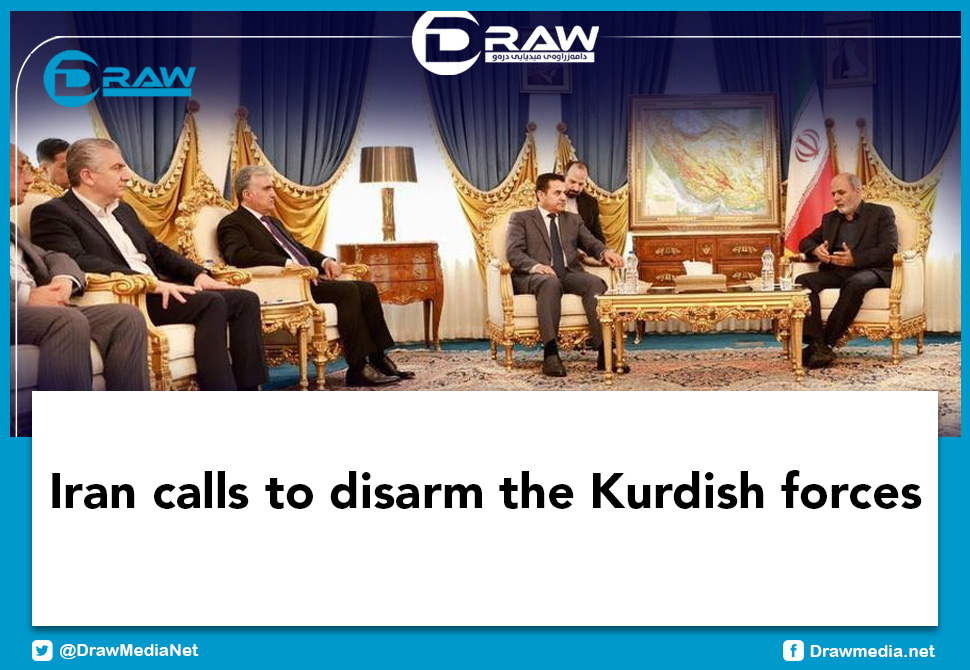
Iran calls to disarm the Kurdish forces

Iran has called on the Kurdistan Democratic Party (KDP) and the Patriotic Union of Kurdistan (PUK) to disarm Kurdish forces in the east of Kurdistan and deploy them in two UN camps in Erbil and Sulaymaniyah, or expel them from the Kurdistan Region and Iraq. Both sides agree, but before implementation, they asked Qasim al-Araji to go to Washington and warn them, so that the Kurdistan Region does not face US pressure. Two conditions ! Kurdistan Regional Government Interior Minister Rebar Ahmad, Head of the Kurdistan Regional Security Agency Hiwa Ahmad, and Iraqi National Security Council Advisor Qasim al-Araji visited Tehran. The visit was to discuss the latest measures related to border security, referring to the recent agreement between Iraq and Iran, the agreement is specific to control the borders of the Kurdistan Region with Iran. Four days ago, before going to Tehran, Qassem al-Araaji visited Sulaimani and left the Kurdistan Region for Iran. Araaji went to Erbil a month earlier for the same purpose. According to the information obtained by several sources, during the visit to Tehran, Ali Akbar Ahmadian, Secretary General of the National Security Council of Iran, who recently replaced Ali Shamkhani, put two demands before the joint security delegation of the Iraqi government and Kurdistan Region :  • First: Iranian opposition forces should be disarmed inside the Kurdistan Region and placed in two UN camps in Sulaimani and Erbil. • Second : Or these parties should be armed and expelled from the Kurdistan Region and Iraq. Hiwa Ahmad, representing the PUK, and Rebar Ahmad, representing the KDP, listened to Iran's latest demand on the fate of the Kurdish parties in the east and reportedly agreed with Iran's demands, but asked not to rush them. Kurdistan between Tehran and Washington Before his visit to Tehran, Reber Ahmad told Qasim al-Araji that the Kurdistan Region is committed to the security agreement between Iraq and Iran. A source told Darw Media that the PUK and PDK have requested that, an Iraqi security delegation to visit the United States to inform them of the situation, so that the United States does not put pressure on the Kurdistan Region while implementing Iran's demands. Iraqi National Security Advisor Qassim al-Araaji is scheduled to visit Washington in the coming days at the request of the PUK and KDP, the source said.

Read more

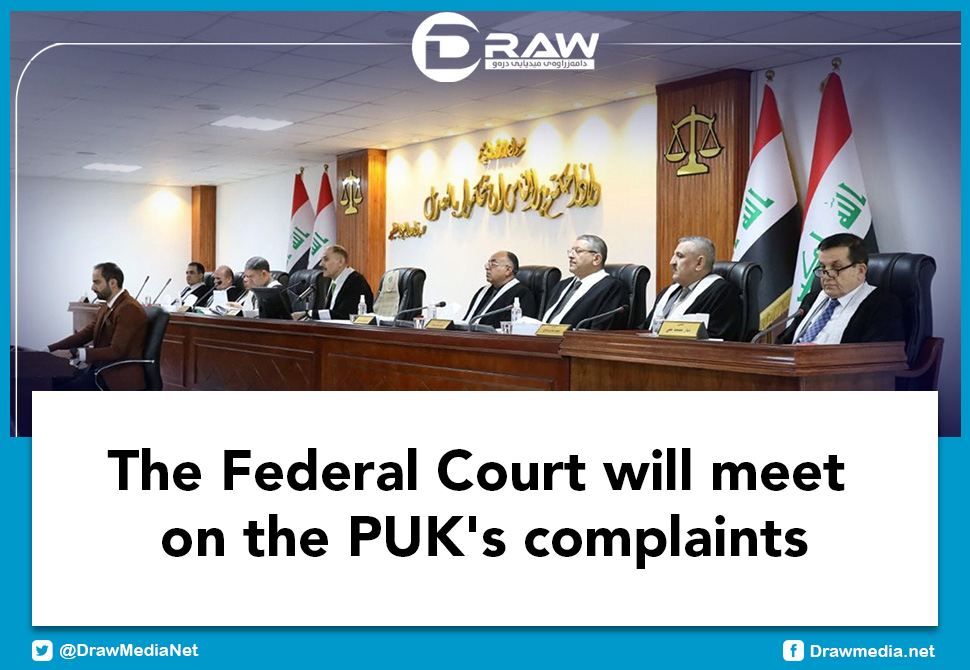
The Federal Court will meet on the PUK's complaints

The Federal Court is scheduled to meet on June 11, 2023 on the complaints of the PUK on the issue of (The quota seats, electoral system and the voter registration). Which are related to the electoral Law in the Kurdistan Region: Earlier this month, the PUK filed a number of complaints against the speaker of the Kurdistan parliement through its faction. - The quota seats in the Kurdistan Region - Voter registration and file registration system - Electoral system and single constituency in the Kurdistan Region According to Draw Media information, its scheduled that hearing on the complaints of the PUK will take place on June 11, 2023.  

Read more

The problem of border crossings

Draw Media Out of the 32 border gates in the Kurdistan Region, only six have been officially recognized by Baghdad. 13 companies operate at the border gates. Eight different forces guard the border points. The goods imported to the Kurdistan Region are not subjected to all the necessary inspections. • There are 32 border gates in the Kurdistan Region, 6 of which are officially recognized by the Kurdistan Region and Baghdad, and 20 of which are not recognized by the Kurdistan Region and Baghdad, (6) other gates are only recognized by the Kurdistan Region and not officially recognized by Iraq. • The volume of trade between the Kurdistan Region, Turkey and Iran was ($16 billion), of which 48% was through Turkey, 18% through Iran, and the rest with other countries. • KRG customs revenue in 2022; Monthly (140 billion) dinars. That was (1 trillion and 680 billion) dinars yearly, out of (4,800,000,000,000) dinars, which is the annual non-oil revenue of the Kurdistan Regional Government. • In the Iraqi budget law, the revenue of the border points of the Kurdistan Region is estimated at (1 trillion and 560 billion) per year, which means that the revenue of the border points accounts for about 35% of the non-oil revenue. • (13) companies in different fields participate in the management of the border points of the Kurdistan Region, all these contracts were without competition, 25% of the revenue of the border points of the Kurdistan Region goes to the expenses of the companies. • Eight different security and military forces are on duty to protect the customs gates of the Kurdistan Region. • 80% of the products and goods imported to the Kurdistan Region are not subjected to all the necessary inspections. Prepared by: Stop Organization/ Supported by the National Endowment for Democracy (NED)

Read more

Judicial Council unable meet to swear in the two members of the Electoral Commission

Draw Media The Kurdistan Judicial Council is scheduled to meet today and the swearing-in of the two new members of the Election Commission is on the agenda, but the quorum of the meeting has not yet been reached. Because it requires the presence of (3/4) of the members. That is, 6 out of the eight members of the Judicial Council, must be present. The Judicial Council currently consists of eight members, three of whom are from Sulaimani and five from Erbil and Duhok. After the session of the Kurdistan Parliament on May 22 and the chaos in the hall and the adjournment of the session by the Speaker of the Kurdistan Parliament, the Deputy Speaker of the Kurdistan Parliament has sent a letter to the Judicial Council to re-activate the commission and appoint two members (Ali Bandi and Kamran Nashat Bakr). The swearing-in of the two members of the commission, is in today's agenda of the Judicial Council. However, according to (Draw) information the quorum of the meeting has not been reached yet, because the meeting requires the presence of (3/4) of the members. According to the second paragraph of Article (33) of Law No. (23) of 2007 of the Judicial Council of the Kurdistan Region, the meeting of the Judicial Council requires the presence of (3/4) members. Currently, the Judicial Council has (8) members, which means (6) members must be present for the meeting.  According to (Draw) information, so far, the three members of the Sulaimani judicial council have not showed up for the meeting, so the meeting of the judicial council will not meet the quorum requirements. According to paragraph (a) of Article 3 of the Rules of Procedure of the Judicial Council of the Kurdistan Region, "the meeting of the Judicial Council shall not be held until three-fourths of the members of the council are present. Therefore, the Judicial Council has not been able to organize its meeting and the two members of the commission to swear- in.  

Read more

The changes in the share of the region are dishonesty against the region

While he was harvesting with farmers in Erbil, Masrour Barzani, Prime Minister of the Kurdistan Region of Iraq said that, “the changes in the Kurdistan Region's share of the federal budget are dishonesty, oppression and conspiracy against the Kurdistan Region, but we will confront this conspiracy in any way and will not allow it to succeed.” The prime minister also criticized the Kurdish parties who cooperated in issuing this decision, "What is unfortunate is that the local parties involved in this conspiracy," he said. “Even worse, they should consider the reduction of the powers of the Kurdistan Region as an achievement for themselves. But Barzani emphasizes that they assure people that this is a sterile attempt and will not succeed.

Read more

All Contents are reserved by Draw media.
Developed by Smarthand