Draw Media
News / Kurdistan

Analyzing Russia’s Involvement in Iraq and the Kurdistan Region’s Energy Sector

Draw Media Bahrooz Jaafar .   Key takeaways: Russia and Iraq have owned rich oil and gas resources and a common interest in fostering a favorable energy investment and trade atmosphere. Russian-Iraqi cooperation in the energy sector has bloomed with the significant participation of major Russian energy companies (Rosneft, Gazprom, Lukoil, and Bashneft) in Iraq's burgeoning oil industry. Russia's economic hegemony in Iraq will reach $19 billion in 2023.   Russia, along with its main geopolitical ally, China, has embarked on trade and investment in Iraq. They probably want to control everything and are seeking an end to Western hegemony in the Middle East from Iraq!    Russian hegemony began in three stages in the Kurdistan Region (northern Iraq) in 2017, and by the end of 2023, the Russian company Lukoil had almost controlled most of the rich areas in the south of Iraq.   Introduction As geopolitical chess pieces move, Moscow, with Beijing as its ally, strategically advances towards controlling the energy narrative and investment in Iraq, an effort to distance Baghdad from Western energy engagements and align it with the emerging Iran-Saudi Arabia axis.  By the year 2023, Russia's stake in Iraqi energy would have reached $19 billion. Furthermore, in March 2023, the Iraqi state-owned Dhi Qar Oil Company (DQOC) ratified the development plans for Block 10 reserves. These include the entire Eridu field, the largest oil field discovered in Iraq since 2003. Preliminary estimates indicate that Iraq's Eridu oil field has between 7 and 10 billion barrels of reserves. The exist of Inpex, a Japanese corporation, from its 40 percent holding in Block 10, which boasts the substantial Eridu discovery, has facilitated a streamlined path for Lukoil to assert dominance over this resource-rich expanse. Concurrently, the departure of Exxon Mobil from the lucrative West Qurna oil field in Basra has allowed Lukoil to reacquire its shares. The tapestry of military and energy collaborations between Russia and Iraq paints a picture of their deepening cooperative relationship. An enterprise such as Lukoil has channeled up to $11 billion into Iraq’s southern provinces, notably the Basra region. Beyond the oil fields, the maritime sector emerges as a fertile ground for Russian-Iraqi collaboration. With Iraq’s strategic placement along critical maritime conduits complemented by Russia’s seasoned expertise in port development and maritime logistics, the convergence of interests is unmistakably evident. Such collaborative ventures aimed at enhancing Iraqi port infrastructure and fostering robust maritime cooperation are anticipated to significantly bolster the efficiency and throughput of Iraq’s maritime trade routes, attracting heightened trade and investment flows. The discourse then shifts to probe the genesis of Russia’s involvement in Iraq. It questions the catalysts behind Russia’s strategic shift in the region. Do the Russian and Chinese strategic projects in Iraq and its vicinity propose a rectification of historical injustices dating back to the post-World War I era? What ramifications do the oil and gas resources of Iraq and the Kurdistan Region hold for Russia’s geopolitical ambitions? And what historical-political narratives could the Russian presence in the region be scripting for Iraq and the Kurdish populace?   Context and Limits of Discussion In the broader context of global geopolitics, the preference matrix for global powers and industrial magnates remains skewed towards ensuring national security and fostering a competitive edge in energy distribution. This was evident at the COP28 climate change summit in Dubai, held from December 1 to December 4, 2023, where 134 nations inked the UAE Declaration. The summit saw an assembly of over 70,000 participants, including government leaders from 200 countries and a congregation of decision-makers, scientists, experts, heads of state, and members of international bodies, engaging in earnest dialogues to unearth solutions and financial strategies for climate change initiatives. Within this complex weave, Simon Watkins—esteemed financial journalist, former head of institutional forex sales and trading, later director of forex at the Bank of Montreal, and a geopolitical risk consultant to major hedge funds in London, Moscow, and Dubai—sheds light on Russia’s geopolitical maneuvers. His 2023 publication, The New Global Oil Market Order And How To Trade It, delves into Russia’s strategic advances in Iraq and the Kurdistan Region from the onset of 2017 through the culmination of 2023. Watkins elucidates how these developments have altered the dynamics of the global oil market, forging new paradigms and dictating novel rules of engagement. For Watkins, the quintessence of oil in determining a nation’s economic destiny is unequivocal. Its influence is so profound that it molds both domestic and international policy of major oil producers and consumers. In a realm where the stakes tower high, the key players in the global oil theatre are inclined to employ every conceivable strategy to secure an advantage. The trader, thus, must remain vigilant of the seismic shifts that have transpired over the recent years, particularly with the advent of the COVID-19 pandemic reshaping the conduct of the world’s leading oil market stakeholders and redefining political and diplomatic strategies at the regional echelon. Russia Began to Manipulate the Region from the Kurdistan Region It was from the Kurdistan Region that Russia initiated its strategic manipulation. Rosneft and Gazprom, behemoths that function as extensions of the Russian state apparatus, though commercial in their pursuits, ultimately serve the Russian government’s directives, Vladimir Putin’s vision, and the plethora of entrepreneurs whose fortunes are tethered to uninterrupted access to global energy reservoirs. Since 2018, through a series of calculated business transactions, Rosneft has emerged as a notably assertive arm of Russian state interests. Its prominence is underscored by hefty investments across key foreign policy theatres for Russia, spanning the Arctic, China, Vietnam, Venezuela, Africa, and the Middle East. In June 2017, a Kurdistan Regional Government delegation led by Prime Minister Nechirvan Barzani, Deputy Prime Minister Qubad Talabani, and Minister of Natural Resources Ashti Hawrami visited Russia on the sidelines of the St. Petersburg Economic Forum, which included 130 leaders. The country, which attracted 12,000 people, signed a contract with Ross Oil. In general, oil and gas contracts are between the product's owner, the party involved in the export route, and the buyer. According to the agreement between the Kurdistan Region and Rosneft, the cost of building a liquefied gas pipeline from the Kurdistan Region to the market Rosneft wants is $1 billion. Since 2017, the Russian energy giant has lent $3.5 billion to the Kurdistan Regional Government (KRG) and signed contracts to develop five oil blocks. As of April 2018, the parties had agreed to implement a geological exploration program and commence pilot production. The agreement comes as the two largest US energy companies, Exxon Mobil and Chevron, left several fields in the Kurdistan Region in 2015 and 2016. During the war against ISIS, the federal government of Baghdad did not pay the salaries of the Kurdistan Region or the cost of the Peshmerga forces. In 2017, the Kurdistan Region was moving towards an independence referendum. Kurdistan's leaders understood that the United States would not support the Kurds in their problems with Baghdad or in achieving political independence. The Kurdistan Regional Government (KRG) voted for independence in the referendum, which failed due to pressure from the Iraqi government and a lack of support from the United States.   St. Petersburg, Russia (June 2017): The KRG's PM Nechirvan Barzani, Deputy PM Qubad Talabani and the KRG'S Natural Resources Minister Ashti Hawrami signed a contract with Rossneft CEO Igor Sechin. From the beginning, for Iraq, the endgame has been evident in Russia's effective takeover of the oil and gas industry in Iraq's troubled Kurdistan Region to the north. Russia's control over Iraqi Kurdistan, through proxies of state companies, especially Rosneft, has been ensured since the autumn of 2017 through three mechanisms: First, it provided US$1.5 billion in financing through advanced oil sales payable over the next three to five years. Second, it received an 80 percent working interest in the region's five major oil blocks and the resulting investment and technical and equipment assistance. Third, 60 percent ownership of the critical pipeline previously built by the Kurdistan Regional Government (KRG) by committing to invest $1.8 billion to increase its capacity to 1 million barrels daily. Subsequently, Russia has manipulated its region and has entered into a surprise confrontation with the Iraqi central government in Baghdad, the final stage of its plan to effectively incorporate the Iraqi Kurdistan Region into all other parts of Iraq. By the end of 2023, Russia will be fully involved in Iraq's gas sector. With this in mind, Russia and China are now moving to secure their dominance over the whole of Iraq. Removing Inpex from the vast Eridu field is the latest example of their expansion strategy at work. From the inception of the Soviet Union in 1922, Russia’s foreign policy has been characterized by an impulse to extend its influence into regions of turmoil. The current Russian endeavor to assert its will in the Middle East, building upon its aggressive posturing in neighboring Iran, is therefore in keeping with historical precedence. The objective in September 2017 was not just to extend Russian influence into Iraq, but to maneuver in the semi-independent Kurdistan region as a precursor to broader dominion over southern Iraq. With this, Russia aims to preside over the unification of northern and southern Iraq under its influence, thus affirming its long-standing expansionist ambitions. Tracing the Energy Alliance: Russia and Iraq’s Shared History. Michael Barantschik, an expert on the background of the oil and gas industry in the Middle East, traces trade and investment relations between Russia and Iraq back to a long and complex history. In the Middle Ages, merchants and explorers from both regions met, traversing the Volga and Caspian Sea trade routes and establishing early trade networks between what would much later become Russia and Iraq. Formal diplomatic relations were established on September 9, 1944, and despite a brief hiatus between 1955 and 1958, relations between the two countries grew, and Baghdad was seen as a significant Soviet partner in the Arab world. In 2008, Russian President Vladimir Putin forgave much of Iraq's Soviet-era debt, setting the stage for a US$4 billion oil deal. This gesture marked the beginning of a deeper economic play, which was further solidified in 2012 with the significant contributions of the Russian oil company Luke Oil in the Iraqi energy sector. Recent relations between the two countries have further strengthened Russia's involvement in Iraq's oil sector. In February 2023, Russian Foreign Minister Sergei Lavrov visited Baghdad. One of the main issues discussed was the funding mechanism for Russian energy companies, which reflects a mutual interest in continuing and expanding economic ties despite Western sanctions. This was also the topic of discussions between Iraqi Prime Minister Mohammed Shaia al-Sudani and Russian President Vladimir Putin on October 10 and 11, 2023, during their meetings at the Kremlin, which took place against the backdrop of the ongoing conflict in Ukraine and the situation in the Middle East. Strengthening relations between Russia and Iraq covers all areas. In 2022–2023, Russia will provide 200 free education courses at various levels for Iraqi citizens. In addition to contracts with Russian companies, Russia and Iraq have signed agreements to boost cooperation in the oil sector, including exploration and drilling projects and infrastructure development. These agreements are a significant step towards deepening their energy ties and ensuring a steady flow of investments vital to the growth and sustainability of the Iraqi oil industry. Furthermore, Iraq and Russia also coordinate in the gas sector. With Iraq aiming to reduce flaring and Russia having extensive experience in gas production and processing, there is a natural synergy to help. Technical assistance, joint investment in gas processing facilities, and data transfer could be further explored to benefit both countries.   The Engagement of Economic Contributions Makes Strategic Projects Bolder The concentration of economic contributions in the energy sector highlights the need for diversification to ensure a balanced and sustainable economic relationship. Exploring new avenues for economic cooperation across different sectors, including agriculture, technology, manufacturing, human capital, and skills development, can foster a diversified economic engagement, thereby enriching economic ties between Russia and Iraq. Transportation and infrastructure are important elements in Russia-Iraq bilateral relations, forming the backbone for enhanced trade, economic cooperation, and regional connectivity. Iraq has launched a $17 billion project to strengthen its transportation infrastructure, aimed at connecting a major port of goods from the south (Faw Port) by rail and road to the north and the Turkish border to a regional transport hub by developing its road and rail infrastructure, thereby connecting Europe with the Middle East. The project stretches 1,200 kilometers from Turkey to the Gulf and is seen as a cornerstone of a sustainable non-oil economy and a means to foster economic integration within the region. Also, the project symbolizes a strategic move to enhance trade flows, reduce transportation costs, and improve market access. By investing in the construction of the railway, Russia and Iraq are laying the groundwork for a robust logistics network, which will not only benefit bilateral trade but also create a ripple effect on regional trade dynamics. Although Iraq is an unstable country in every way, the political situation, conflict between different communities, and external interference have hindered the country's transformation from bad to good and from good to better. However, having a strategic and geopolitical vision that fully affects the economic, cultural, and technological elements and revives the general business environment is a strong possibility to get Iraq out of the mud of the past decades, such as in 2023, by building roads and modernizing airports. Urban development initiatives have begun.     The Ongoing Turmoil in Kirkuk: Russia Came, and British Petroleum Left Iraqi oil was domesticated in Kirkuk, the birthplace of the Iraqi oil industry. In September 2013, British Petroleum (BP) signed a memorandum of understanding with the Iraqi Oil Ministry's Northern Oil Company to support $100 million in field exploration and research in Kirkuk. The arrival of ISIS in 2014 and the seizure of Kirkuk oil fields by Kurdish forces delayed BP's operations. In early 2020, after completing a survey and technical study of the field, BP left the results of their work and laptops to Northern Oil Company. Iraq had hoped BP would help triple production from the fields to 1 million barrels per day, more than one-fifth of Iraq's current output and 1 percent of global output. According to the Mediterranean Institute for Regional Studies, access to BP's data and statistics has not been easy, but the signs after BP's departure from Kirkuk have not been promising for the Iraqi government and Northern Oil Company. They would have extended their stay if the study results had incentivized BP and the West. In addition, most of Iraq's crude oil is produced in areas administered by the central government of Baghdad and exported from the south and southern Gulf ports. After ISIS blew up the Kirkuk-Ceyhan pipeline in 2014, the Kurdistan Regional Government exported about 300,000 barrels of crude oil daily through the Kurdistan-Ceyhan pipeline to Turkey from 2014 to October 2017 until Russian companies withdrew and stabilized the Kurdistan Region and Iraq recovered from the war against ISIS. With the regional support of Britain and the United States, the Iraqi central government regained control of the oil fields in Kirkuk and ended the rule of Kurdish forces in the city. Why is Russia Insisting on Expanding its Hegemony in the Region? One of the concepts that Russian thinkers have been working on since the Cold War is Eurasia. Eurasia is a complex concept because it still needs a geographically unified identity, whether it refers to Asia and Europe or the regions connecting Asia and Europe. Russia, Iran, Iraq, and Syria have the world's largest oil and natural gas reserves. Wherever Eurasia is, Russia will do everything to change the unipolar system and governance of the world, and to do so, it must be present in the strategic energy basins in which the West dominates. Turkey is at its heart wherever Eurasia is, and any Russian energy pipeline from the Kurdistan Region or Iraq must be a key party to the deal. Turkey is positioned on the Mediterranean Sea, and the Black Sea, and overlooking the Caucasus and Eurasia, Turkey is part of Europe and a major part of the Middle East. Robert D. Kaplan, a professor and geopolitical expert, wrote a book in 2018 entitled "The Return of Marco Polo: US War, Strategy, and Interests in the 21st Century." It identifies the situation as a transient moment that must be felt on two levels: First, the United States must counter Chinese hegemony in the Atlantic and right-wing populism in Europe. Second, according to Kaplan, geography and technology intersect. That is why Russia has always dominated Eastern Europe. In Eastern Europe, protests against the system have led to the rise of right-wing and popular movements. This will ensure Russia's interests. This shows us that Russia will be wherever the West sees it as interesting. Suppose Russia has the Eurasian Project and leads the Caspian Basin, and since May 29, 2014, the Eurasian Economic Union (EAEU) has been formed. The Arabian Gulf basin has the Gulf Cooperation Council (GCC). Natural gas has been discovered in the eastern Mediterranean since 2010. The main natural gas producers in the sea and offshore are Israel, Cyprus, and Egypt, more than 20 countries. They have created the Eastern Mediterranean Gas Forum (EMGF) since China also has a road belt and project in the region. How will the Kurds deal with these strategic projects? Hydrocarbons Have Threatened the Security of the Kurdistan Region In an eyeshot of the pattern of past events, the Kurdish issue has been played out among the regional forces. The complex hydrocarbon issue requires a comprehensive strategic project from Kurdish leaders. The panorama of events since 2017 has dealt a severe blow to the political economy and national security of the Kurdistan Region: In September 2021, the United States provided $250 million in financial support to the Khor Mor gas field to expand the field's stations (known as KH250). The field is expected to produce 750 million cubic feet per day by the end of 2024 and 1 million cubic feet per day the following year. UAE Crescent Petroleum has operated the field since Since 2021, the Kurdistan Region and Turkey will move forward in relations with the Gulf countries in the same direction. The leadership of the Kurdistan Regional Government has reportedly played a central role in facilitating direct dialogue between Turkey and the UAE, although this may be secondary. However, reporting on the KRG's participation is evidence of the central role played by the KRG. In early February 2022, Iraqi Kurdistan Regional Government President Nechirvan Barzani traveled to Ankara to discuss closer energy ties with Turkish President Recep Tayyip Erdogan. That same month, the Kurdistan Region announced extending its gas pipeline network to the Turkish border, ensuring an extensive gas supply through a 112-mile pipeline. This step encouraged Kurdistan's export capabilities and showed that Turkey's position as a major gas supply hub, especially for European markets, is always under consideration. Two weeks after Nechirvan Barzani visited Ankara, Prime Minister Masrour Barzani discussed Kurdistan's gas potential during a visit to Qatar and the United Arab Emirates. In 2022 and 2023, the Kurdistan Regional Government (KRG) President and Prime Minister visited the UAE and Qatar 11 times separately. The above movements were not without risks and challenges: Iran and Shiite militia groups in Iraq (Probably with Russia's knowledge) have launched several open attacks on the Kurdistan Region's energy sector, directly and indirectly. From October 2022 to January 2023, the Khor Mor field was attacked thrice with Katyushas and drones. On March 13, 2022, Iran fired 12 missiles at the residence of Sheikh Baz Barzanji, owner of the Kar Group of Companies, in the Kurdistan Regional Government's capital, Erbil (Kar group and 60% by Rosneft own 40% of the Kurdistan Pipeline).  The Kurdistan Region suffers from political-internal division. On April 28, 2022, The president of PUK met with several consul generals and diplomats in Erbil to discuss the exportation of the Region's natural gas and the latest developments in the issues relating to Sulaimani's financial situation and the Region's upcoming parliamentary elections. "The contract and its method must be explained to the people of the Kurdistan Region… The case should be worked on transparently, and Kurdish people are a part of this process. Any efforts outside these requests, I announce clearly and publicly, they will have to export gas pipelines over Bafel Jalal Talabani's dead body," Talabani said in a statement. Only a week after the Talabani's expression, arrows hit Bafel Talabani's party: One of the prominent security officials of Talabani's party, who worked on sensitive cases, fled from Sulaimani to Erbil, which is under the control of the Kurdistan Democratic Party (KDP).   Conclusion Russia’s increasing involvement in Iraq and the Kurdistan Region’s energy sectors reflects a broader pattern of economic ambition and strategic positioning. However, the path to solidifying these ties is littered with internal and external challenges. Geopolitical tensions, international sanctions, and a complex regulatory environment create significant obstacles to economic cooperation. Engaging in an ongoing dialogue at the bilateral and regional levels is essential to address these concerns and foster a stable environment for economic collaboration. Strengthening financial infrastructure and exploring alternative financing mechanisms can mitigate financial barriers, facilitating trade and investment flows between Russia and Iraq. The Kurdistan Region's energy sector, with its poor economic ability and internal divisions in such a region, is waiting for a comprehensive strategic project to strengthen its natural resources and be able to carry out a geopolitical transformation, thereby increasing its political, economic, diplomatic, and security strengths.   Bahrooz Jaafar holds a Ph.D. in International Relations from Cyprus International University in Nicosia, and he is also the founder and head of the Mediterranean Institute for Regional Studies.

Read more

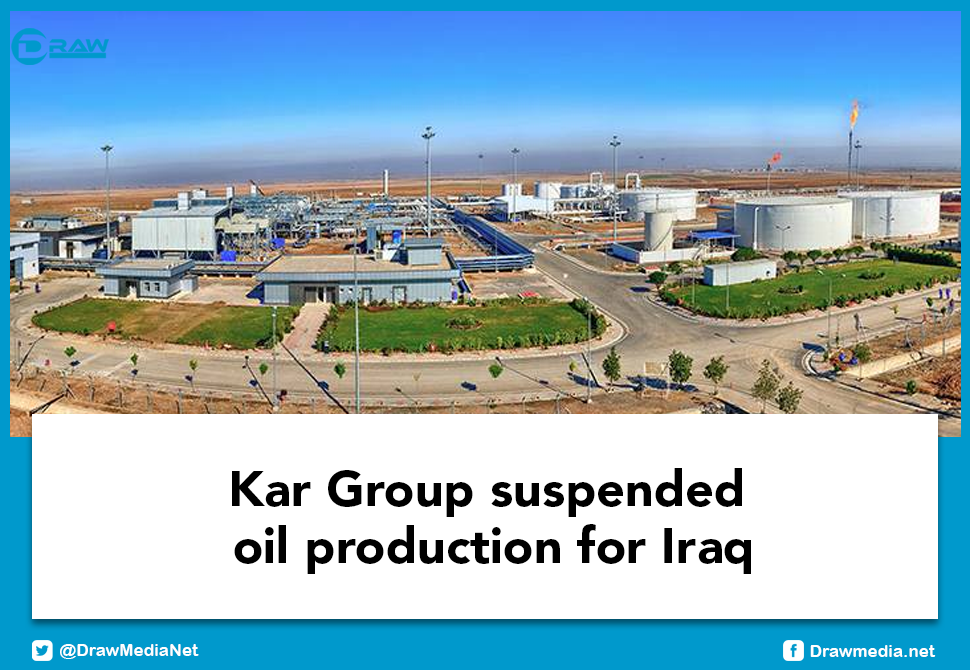
Kar Group suspended oil production for Iraq

Kar Group has suspended oil production for Iraq due to non-payment of the production costs, which supplied Iraq by 85,000 barrels of oil on a daily basis.  In the past five months, 11 million barrels of oil were produced by Kar Group from its refineries, at the same time it refined oil and gasoline for Nineveh province. The total amount of oil produced during this period is worth more than (260) million dollars and it has not been spent by the Iraqi government. According to Darw Media, it has been for two weeks since Kar Group has suspended oil production for Iraq. Kar has produced about 11 million barrels of oil since the end of June but has not received the wages. "On June 25, the Iraqi Oil Ministry asked us to start producing oil from 50,000 to 140,000 barrels," Kamal Mohammed, the Kurdistan Regional Government's minister of natural resources, said in a news conference. “We handed over the oil to the Kar refinery, which works for Iraq. We are now supplying an average of 85,000 barrels of oil per day, but not a dollar has been spent on the oil production since then.” He added. The Iraqi governments excuse for not spending Kar Group financial entitlement is that they only spend $6 per barrel for production and transportation. According to the minister of natural resources the disputes over the price of oil production and transportation between the Kurdistan Region and Baghdad are because of the contracts. As he mentioned, “the Kurdistan Region contracts are different from those of Iraq, because Iraq has its own national oil production company. but we do it through the international companies.  On August 24, we met with the companies and told them that the fixed price for oil production and transportation by the Iraqi Ministry of Oil is $6 which has been approved in the Iraqi budget. "The companies all responded officially and said we could not continue producing oil at that $6." According to the report of the Economic Office of the Federal Ministry of Oil, the cost of production and transportation of oil per barrel is (8 thousand 960) dinars, which is (6.9) dollars. The Ministry of Natural Resources of the Kurdistan Region of Iraq (KRG) has determined the average of oil production expenditure of (32.91) dollars, as follows: • Amount (24,32) dollars, to produce a barrel of oil • The amount of (6.9) dollars, to transport a barrel of oil According to the price that the Ministry of Natural Resources believes that Baghdad must spend a barrel of oil production for its companies, which is (24) dollars The price of the oil delivered to Baghdadi in the past five months was $264 million for 11 million barrels of oil. However, according to the price set by the Iraqi Oil Ministry which is (6) dollars per barrel, the total amount of money that has to be spend on the 11 million barrels is 66 million dollars.  

Read more

Results of Draw Media survey on the Kirkuk elections

Survey results: Opinion of Kurdish citizens in Kirkuk about the Kirkuk provincial council election and the national reality in Kirkuk Only 19 percent of the sample say, the Kurdish parties disputes over territory and nation. In contrast, 38 percent said they were fighting for positions and privileges, while 36 percent said they were fighting for oil and revenue. The experience of the region does not seem to have had a positive impact on the issue of nationality and identity among the Kurds of Kirkuk. In response to a question, 44% said they wanted to be a region within Iraq and did not choose to belong to the Kurdistan Region. Even about 22 percent of the sample believe that they should not think about an independent region within Iraq and said it is better to stay as it is now. (About 1300 people have answered this question)   ?Results of the Survey: "Opinion of Kurdish citizens in Kirkuk regarding the Kirkuk provincial council elections"   ?(63%) of the respondents believe that the candidates represent the parties, not the Kurds ?(47%) of the respondents believe that the elections will not solve the problems of Kirkuk ?(63%) of the respondents predict that the next governor of Kirkuk will be for the Kurds ?(69%) believe that the living conditions of Kirkuk residents are better than the Kurdistan Region ?(40%) believe that the political and financial situation in Kirkuk has worsened after October ?(46%) of the participants believe that fraud is committed and (16%) say that fraud is not committed ?(44%) say Kirkuk should be a region within Iraq, (34%) say it should be included in the Kurdistan region

Read more

Two-month teachers’ strike underscores severity of Baghdad-Erbil problems

IRAQ OIL REPORT The fall semester still hasn't started for public school students in Kurdistan's Sulaimaniya province due to financial and political dysfunction. Nearly a million students in Sulaimaniya province have been out of school for over two months in the longest teachers' strike in the history of the Kurdistan Regional Government (KRG) — a consequence of unresolved oil and financial disputes between Erbil and Baghdad. Over 58,000 teachers are refusing to work until the government catches up on three months' worth of salaries that have gone unpaid due to a cash shortfall, according to Ahmad Sabir, president of the Kurdistan Teachers' Union. The severe educational disruption highlights the extent to which Iraqi Kurdistan faces destabilizing financial problems even after receiving loans from Baghdad as part of a temporary agreement to help bridge the KRG's budget gap. Before this year, the KRG’s longest-ever public school closure was in 2016 and 2017, lasting 52 days, according to Sabir. "This time, it is longer," he said. "I still cannot tell when the strike will end."

Read more

 Korek Telecom faces total suspension over unsettled debt

Medya News Erbil-based telecommunications giant Korek Telecom is facing a severe crisis, as the Iraqi parliamentary committee increases pressure on the company, urging the Communications and Media Commission (CMC) to cut off its connections permanently unless it resolves financial disputes. The company's CEO is Sirwan Barzani, nephew of Massoud Barzani, leader of Iraqi Kurdistan's ruling Kurdistan Democratic Party (KDP). The Iraqi parliamentary committee has stepped up pressure on Erbil-based telecoms giant Korek Telecom, urging the Communications and Media Commission (CMC) to cut off the company’s connections permanently if it doesn’t resolve its financial disputes with the government, Roj News reported on Saturday. With seven million Korek users already cut off from all networks, the threat of further damage looms large if the debt issue persists. Iraq already blocked Korek Telecom from sending and receiving communications through domestic and international carriers in early November over unpaid financial obligations, after the CMC declared victory in a court ruling against Korek Telecom, ordering the company to pay a hefty $800 million to the Iraqi treasury. The CMC cited a number of financial, legal and technical issues, as well as Korek Telecom’s failure to comply with court rulings by the Supreme Judicial Council, as reasons for its blocking decision. As a result, Korek subscribers were unable to make or receive calls and messages from other domestic and international mobile operators. The CMC ordered Korek to pay $800 million in taxes within 15 days, a decision the company reportedly agreed to, according to Kurdistan24. Sirwan Barzani is the CEO of Korek Telecom, a company worth more than $2 billion with nearly 3,500 telecommunications towers across Iraq. He is also the nephew of Massoud Barzani, leader of Iraqi Kurdistan’s ruling Kurdistan Democratic Party (KDP), and a cousin of the President of Kurdistan, Nechirvan Barzani. In addition to Korek Telecom’s troubles, Sirwan Barzani faces further legal complications stemming from a loan made in 2007 by Alcazar Capital Partners, which is owned by the Kuwaiti logistics company Agility. The loan, which was intended to pay for Korek Telecom’s national mobile phone licence, was not repaid, leading to a court ruling that the Kurdistan Regional Government (KRG) must pay $490 million in compensation. In a separate development, the International Court of Arbitration in Paris found Korek liable and awarded $1.65 billion in damages to Kuwaiti logistics company Agility. The case, which dates back to 2011, involved a joint venture between the French telecoms giant Orange and Kuwait’s Agility, which acquired a 44 percent stake in Korek for $810 million with the approval of the CMC. The situation is further complicated by revelations from the International Consortium of Investigative Journalists (ICIJ) Ericsson List report in 2022, according to which Ericsson managers approved a $50,000 cash request in 2014 from Sirwan Barzani, who at the time was both chairman of Korek and de facto head of the Kurdish peshmerga forces. The funds were earmarked for a charity controlled by Barzani, raising suspicions of irregularities and forged signatures.

Read more

In the past 18 years, participation in the elections has decreased from 95% to 35%

? Level and rate of participation and boycott in the general elections; ? From the first round of Kurdistan parliamentary elections on (19/5/1992) to the fifth round on (30/9/2018), The turnout rate decreased from (87%) to (60%), The boycott rate has increased from 13% to 40%. ? In the first round of the Iraqi parliamentary elections "at the level of the three provinces" from (30/1/2005) to the last round held on (10/10/2021), The turnout from (95%) to (35%) ) decreased,  The election boycott rate rose from (5%) to (64%). ? In the first round of parliamentary elections "at the level of (18) Iraqi provinces" from (30/1/2005) to the last round held on (10/10/2021),  The turnout rate decreased from (80%) to ( 43.5%), The boycott rate increased from 20% to 56.5%. ? In the last election and the fifth session of the Kurdistan Parliament on (30/9/2018), for the last session of the Iraqi parliamentary elections "at the level of the three provinces" held on (10/10/2021), The turnout rate fell from 60% to 36%, The boycott rate rose from 40% to 64%.  

Read more

UN Secretary-General's envoy met with journalists and civil society organizations

Volker Perthes of Germany as Head of the Independent Strategic Review of the United Nations Assistance Mission in Iraq (UNAMI)  met with some journalists and civil society organizations at the office of Draw Media Organization in Sulaymanya.  During the meeting, Volker Perthes sought the views of the attendees on the continuation of UNAMI's mission in Iraq and the Kurdistan Region. Journalists and representatives of civil society organizations discussed the political, security, human rights, women's rights, freedom of the media and expression with the UN Secretary-General's representative. Volker Perthes was appointed as the Head of the Independent Strategic Review of the United Nations Assistance Mission for Iraq (UNAMI), to review UNAMI's mission in Iraq and then submit its report to the UN Secretary-General for a final decision on the future of UNAMI in Iraq. \  

Read more

Focus Group (Election Awareness) in Garmian

A focus group on “Election Awareness” was held in Kalar (Garmian province), organized by Darw Media Organization with the financial support of the U.S. Government. The implementation of the project started on Tuesday November 14, 2023 in Kalar district, the center of Garmian administration. A number of young people of both sexes participated in the first (focus group). They discussed the participation of young people in the electoral process. Why do most young people boycott the elections? The (Election Awareness) project will be implemented in (8) focus groups in the four provinces (Erbil, Sulaimani, Duhok, Halabja) and the four independent administrations (Garmyan, Raperin, Soran, Zakho). The project is being implemented by Darw Media Organization with financial support from the U.S General Consulate - Erbil.

Read more

Iraqi Kurdistan to resume oil production within three days

The Iraqi Minister of Oil, Hayan Abdul-Ghani, expected on Sunday to reach an agreement with the Kurdistan Regional Government (KRG) and foreign oil companies operating in Iraqi Kurdistan to resume oil production from the region’s oilfields within three days. During his visit to Erbil, Abdul-Ghani said that Iraq reached an understanding with Turkey in relation to the resumption of Iraqi Kurdistan’s oil exports through the Iraq-Turkey pipeline, according to Reuters. The Norwegian company DNO said last Thursday that international oil companies operating in the Kurdistan region of Iraq will not produce oil for export through a pipeline until the late payments issue, estimated at about one billion dollars, is resolved. The Association of the Petroleum Industry of Kurdistan (APIKUR) mentioned in mid-October that Turkey’s closure of the oil pipeline in March made Iraq, the Kurdistan Regional Government (KRG), and oil producers all lose a total of $7 billion. The Turkish Minister of Energy and Natural Resources, Alparslan Bayraktar, explained in September that the inspection of the oil pipeline between Iraq and Turkey has been completed, and the pipeline will be technically ready for operation soon. Turkey began maintenance work on the pipeline, which, according to Turkish officials, passes through a seismically active area and was damaged by floods. DNO illustrated that the six members of APIKUR, including itself, will not resume exports through the pipeline until it is clear how they will receive their contractual entitlements for the oil that has already been sold and exported. The company added that the accumulated debts owed to the KRG from previous oil sales in 2022 and 2023 exceeded $300 million. Turkey stopped Iraq’s exports of 450,000 barrels per day through the oil pipeline that extends from the Kurdistan region of Iraq to the Turkish port of Ceyhan on March 25. Turkey’s decision to suspend oil exports followed an arbitration decision issued by the International Chamber of Commerce (ICC) in Paris. The decision obliged Turkey to pay Baghdad $1.5 billion in compensation for damages caused by the KRG’s export of oil without permission from the federal government in Baghdad between 2014 and 2018. The KRG began exporting crude oil independently in 2013, a step Baghdad considered illegal.

Read more

Will Iraqi Kurdistan’s rail ambitions lead anywhere?

Amwaj Media İdris Okuducu The Kurdistan Regional Government (KRG) is reviving longstanding efforts to build a railway that would connect neighboring Iran and Turkey through territory it controls. The development follows Ankara and Baghdad’s announcement of a major transit project that would bypass Erbil. Iraqi Kurdish officials seemingly believe that political motivations are behind their exclusion from the massive rail and road endeavor. Development of the KRG railroad faces formidable challenges. The revival of the project is therefore more of a political statement to remind other powers that Iraqi Kurdistan ought to have a stake in regional endeavors as opposed to a serious alternative to the Iraq-Turkey transit route. At the same time, recent developments have shown how key the railway project is for Erbil. After the Covid-19 pandemic postponed progress for several years, an agreement to develop rail infrastructure in the region was signed with a German company in Oct. 2022. Moreover, in June, KRG Minister of Housing and Construction Dana Abdul Karem stated that his ministry’s priority is to implement the project. The main proposed route starts at the Turkish border, at the Ibrahim Khalil crossing. Passing through the governorates of Duhok, Erbil, and Sulaimaniyah, the railway ends at the Parviz Khan border point with Iran. A second potential line links mountainous areas of Iran, federal Iraq, and Iraqi Kurdistan. The project is still in the early preliminary phase. Last month, the KRG announced that it had prepared a feasibility report on the route in conjunction with a Spanish company. However, it remains unclear when the design and tender process will be completed.   The Iraq-Turkey Development Road A big motivating factor for the revival of the KRG rail project is the Iraq-Turkey Development Road or “Dry Canal” project. Announced in March, the 17B USD railway and parallel motorway network will connect the southern Al-Faw port in Basra Governorate to Turkey. The 1,200 km (745 miles) route almost entirely bypasses the Kurdistan region of Iraq on its way to the Turkish border at Faysh Khabur. Of note, Faysh Khabur is administratively part of Duhok Governorate in Iraqi Kurdistan. But it is on the very edge of the Kurdistan region and the potential route would only enter KRG-controlled territory for a small section. Ankara and Baghdad likely believe that they will be able to force Erbil to acquiesce to the endeavor. The KRG’s exclusion from the major infrastructure initiative threatens to undermine its influence. KRG Minister of Transportation Ano Abdoka reacted to the announcement of the Development Road by saying there would be no such project without the Kurdistan region. Abdoka also warned that the planned transit network should avoid “discrimination” against any Iraqis. Baghdad has rejected the notion of any political maneuvering being behind the current setup of the “Dry Canal” project. Iraqi government spokesperson Basem Al-Awadi has claimed that the KRG is not included for “purely technical reasons.” He charged that the Kurdistan region’s mountainous topography is not suitable for the project’s implementation. He also noted that there are plans to include Iraqi Kurdistan eventually down the line. However, some Iraqi Kurds do not believe that technical issues are the main obstacle to the KRG’s inclusion in the project. A senior official from the KRG’s Housing and Construction Ministry told Amwaj.media that the Development Road is a political endeavor aimed at reducing Erbil’s economic and political influence by creating a direct link between federal Iraq and Turkey. Speaking on condition of anonymity, the Iraqi Kurdish official also charged that all sides should coordinate instead of competing with one another. This could see connections built between the Development Road and the KRG’s envisioned railway, he said. The KRG’s railroad project also arrives in the middle of other hot regional debates on transit. The latter includes a new route connecting Europe with India that was announced at a summit of the G20—an intergovernmental forum of most of the world’s largest economies—in the Indian capital New Delhi last month. The India-Europe-Middle East Corridor (IMEC) is a rail and shipping corridor that would pass through Israel, Jordan, Saudi Arabia, and the United Arab Emirates. Notably, it would bypass both Iraq and Turkey. As the Kurdish official who spoke to Amwaj.media acknowledged, the KRG railway would need to work in tandem with the Development Road to be effective. Any failure or setback for the Iraqi-Turkish project, for example through losing out to a new Europe-India route such as IMEC, could thus also harm the KRG’s efforts.   KRG’s railroad challenges The KRG railway project is not a new initiative. The idea of rail routes traversing the Kurdistan region were first brought up in the media in 2006. Development was supposed to begin the following year, but after five years of no construction the project’s implementation was indefinitely postponed in 2012. Since then, Erbil has faced both financial and security challenges to reviving the project. The issues have included cuts to the budget that Baghdad allocated for Iraqi Kurdistan in 2013. This was followed by the onslaught of the Islamic State group (IS) in northern Iraq the following year. The heavy financial and political costs of the Kurdish independence referendum in 2017 also impacted the project. Strong rejection of the plebiscite by Ankara, Baghdad, Tehran as well as western allies including Washington put Erbil in a weakened position. In this context, the railway project remained off the KRG’s agenda for years. Moving forward, one major challenge for Iraqi Kurdish authorities will be to gain Turkey’s consent for any railroad to meet its territory at Ibrahim Khalil rather than Faysh Khabur. Turkish authorities have repeatedly stated that they would like the latter. Ankara would also prefer for any crossing to be under the supervision of federal Iraq, as part of its broader efforts to create direct rail and road links with Baghdad. In other words, it is unlikely that Turkey would give up developing Faysh Khabur to instead work on rail infrastructure for Ibrahim Khalil. There are also major questions about how Erbil intends to finance such a large and strategic project. Estimated to cost over 4B USD, Iraqi Kurdish authorities would need economic backing from both domestic and foreign investors. At present, the KRG is struggling to pay civil servants and has become increasingly dependent on payments from the federal government, particularly as Turkey has for months halted oil exports through the Kirkuk-Ceyhan pipeline. As for Baghdad, it is highly unlikely to help fund a rail project probably viewed as a potential rival to its Development Road.   The Iranian factor Amid the many challenges, one positive point for the KRG is Iran's position, which may encourage more involvement in regional transit projects. As Amwaj.media has reported, major commercial ventures involving Iraq are unlikely to advance without the acquiescence of powerful Iran-backed local actors. In early September, work began on a key Iranian railway project in Iraq. The route, a priority for Tehran, connects the Iranian border town of Shalamcheh with the southern Iraqi city of Basra. This is while the planned Development Road bypasses Iran, meaning that Tehran has little potential economic gain from the project in its current form. Tehran is already in competition with Ankara in the South Caucasus over the Zangazur Corridor. Given the Iranian efforts to avoid being excluded from the latter route, it is unlikely that Iran would allow Turkey to implement a project that could threaten its influence in Iraq. However, the Islamic Republic may be more receptive if it stands to benefit from the KRG railroad, for example through coordination and connections with other projects—including its own rail plans. In this respect, Tehran’s approach may chime with Iraqi Kurdish attempts to widen the pool of those involved in the Iraq-Turkey Development Road. Financial and political circumstances will likely make Erbil’s rail plans difficult to realize. It remains unclear whether the Development Road, the KRG railway—or both—will eventually run on track. But putting its rail ambitions back on the agenda is Erbil’s answer to being bypassed by the Development Road. It reminds other actors, particularly Baghdad, that Iraqi Kurdistan too has a stake in regional projects and needs to be taken into account.  

Read more

Oil companies in Iraqi Kurdistan halt exports until payments issue resolved

The Norwegian company DNO said on Thursday that international oil companies operating in the Kurdistan region of Iraq will not produce oil for export through a pipeline until the late payments issue, estimated at about one billion dollars, is resolved. The Association of the Petroleum Industry of Kurdistan (APIKUR) mentioned in mid-October that Turkey’s closure of the oil pipeline in March made Iraq, the Kurdistan Regional Government (KRG), and oil producers all lose a total of $7 billion. DNO illustrated that the six members of APIKUR, including itself, will not resume exports through the pipeline until it is clear how they will receive their contractual entitlements for the oil that has already been sold and exported. The company added that the accumulated debts owed to the KRG from previous oil sales in 2022 and 2023 exceeded $300 million. Turkey stopped Iraq’s exports of 450,000 barrels per day through the oil pipeline that extends from the Kurdistan region of Iraq to the Turkish port of Ceyhan on March 25. Turkey’s decision to suspend oil exports followed an arbitration decision issued by the International Chamber of Commerce (ICC) in Paris. The decision obliged Turkey to pay Baghdad $1.5 billion in compensation for damages caused by the KRG’s export of oil without permission from the federal government in Baghdad between 2014 and 2018. The KRG began exporting crude oil independently in 2013, a step Baghdad considered illegal.

Read more

Iraq and APIKUR discuss pipeline restart

Iraqi government oil officials for the first time met with representatives of the Association of the Petroleum Industry of Kurdistan (APIKUR) on 8 November 2023 to discuss the resumption of flows from the embattled export pipeline from Iraq to Turkey, according to Reuters. The meeting on Wednesday, held in Dubai, involved APIKUR, Iraqi ministry representatives, the State Organisation for Marketing of Oil (SOMO), and Iraq's North Oil Company in Dubai, according to a statement shared with Reuters. Turkey halted flows through Iraq's northern oil export route after an arbitration ruling in March 2023 by the International Chamber of Commerce (ICC) ordered Ankara to pay Baghdad damages for unauthorised exports between 2014 and 2018. Turkey's Energy Minister in October 2023 said that the pipeline was prepared for shipments to begin, but two senior Iraqi oil officials said at the time that Iraq has not received official notification from Turkey on whether the pipeline is ready. APIKUR's members include international oil and gas firms that have a direct or indirect interest in upstream oil or gas contracts in Iraq's Kurdistan region, many of which have had to stop output as a result of the pipeline closure. During the meeting, both APIKUR and Iraqi government officials emphasised the urgency of resuming full oil production and exports under mutually acceptable commercial terms. But no agreement has so far emerged, a source familiar with the matter reported. "This meeting was an initial step...we anticipate future meetings with all stakeholders," said Myles Caggins, an APIKUR spokesperson in a statement to Reuters. Iraq, OPEC's second-largest oil producer, exports about 85% of its crude via ports in the south. But the northern route via Turkey still accounts for about 0.5% of global oil supply.

Read more

Kurdistan Warns Gas Company of Deals With Iraq

The Kurdistan regional government's Ministry of Natural Resources has warned the United Arab Emirates-based energy firm Dana Gas against any agreement with the Iraqi government to move the region's natural gas without the regional government's permission. "According to the contract with Dana Gas, the company is not allowed to transport gas from Kurdistan Regional Government (KRG) fields to any other place without the approval of the Kurdistan Regional Government," the ministry said in a statement on Monday. The warning statement came on Nov. 6, less than a day after the Iraqi Oil Ministry said it had completed the construction of a 1,050-meter gas pipeline to transport gas from the Khor Mor field in Chamchamal District of the KRG to the disputed province of Kirkuk. The ministry said the project could ensure the transfer from the Khor Mor field of 100 million cubic feet of gas a day to feed Kirkuk's power station and increase the production of electricity. "The company made sure to implement the directions of the deputy prime minister for energy affairs and the minister of oil in supporting the projects of supply and transport of petroleum products to operate power production plants in all governorates," said the Iraq's Oil Ministry. Shipments expected to complicate relations The announced gas shipments, if carried out, are expected to further complicate energy relations between the Kurdistan and Iraqi governments. The autonomous Kurdistan Region has for about nine years exported nearly half a million barrels of oil per day to international markets via Turkey despite Baghdad's stark objections. That changed in late March when Turkey halted the Kurdish exports after losing to Iraq in a legal case in the International Chamber of Commerce about a bilateral agreement between the two entities. Despite the setback, Kurdish leaders insist on playing a role in international energy supply, given the region's abundant natural reserves. With the war between Russia and Ukraine increasing concerns about Europe's gas supply, the Kurds see a renewed opportunity. According to the KRG, the Kurdish region could hold as much as 5.67 trillion cubic meters of natural gas reserves, which amounts to around 3% of the world's total reserves, positioning the region for a potentially prominent role in regional and global gas markets. That Kurdish ambition, however, could be challenged by the Iraqi state, which has been pushing for a stronger central government, especially after the Kurdish 2017 referendum for independence. Dana Gas did not immediately respond to VOA's request for comment on the pipeline. Speaking on the condition of anonymity, a source from Iraq's Oil Ministry told VOA that "all preparations have been made" to begin the transports. "But details such as prices and other things may not have been fully agreed upon yet," the source said. Some wary of deal Within the KRG, the effort has been viewed with suspicion from the ruling Kurdistan Democratic Party (KDP), which says the deal between the Iraqi Oil Ministry and Dana Gas must have had at least the blessings of the Patriotic Union of Kurdistan (PUK), which controls Chamchamal District. "The Khor Mor gas field is under the control of the PUK. Any agreement with Iraq to transport gas from the field to Kirkuk must be known to the PUK," Rebwar Talabani, the former chairman of the Kirkuk Provincial Council, told VOA. PUK spokesperson Saadi Ahmad Pira rejected those claims. "This issue was discussed in today's meeting between the PUK and the KDP. The PUK and the KDP are not aware of the agreement, and this issue is related to the Kurdistan Regional Government," Pira told VOA. Dana Gas currently extracts about 14 million cubic meters of gas per day from Kurdistan, which is used to provide the Kurdistan region's domestic energy needs. The gas field has been a common target of Iran-backed Shiite militias, especially when KRG tensions with Baghdad and Tehran intensify.

Read more

KRG emphasizes that gas should not be transferred without their consent

Kurdistan Region Ministry of Natural Resources has emphasized that gas from KRG's fields should not be transferred without their consent, amid the completion of a gas pipeline in the Khor Mor field. In a statement released on Monday, the Ministry clarified the contractual agreement with Dana Gas Company, stipulating that the company must not transport gas from the Kurdistan Region's fields to any location without the explicit consent of the KRG. The Ministry further highlighted that the required amount of gas for production plants in the region has yet to be provided. Regarding the pipeline's history, the ministry stated, "The pipeline in question has been in existence since the 1980s and has previously been used for candy transportation." In a separate section of the statement, the Ministry of Natural Resources made it clear that on October 2, 2023, they officially conveyed to Dana Gas that "no gas from the region's fields should be transferred to any location, internally or externally, without the approval of the Ministry of Natural Resources."

Read more

Gas is transported from Kormor to Kirkuk

A member of the fifth session of the Kurdistan parliament revealed that Kormor natural gas will be transported to Kirkuk. Ali Hama Salih, a member of the fifth session of the Kurdistan parliament, has posted a picture of a pipeline project in the Kurdistan Region and wrote: Although some of the power plants of the Kurdistan Region are not working due to lack of natural gas, but Kormor gas will be transferred to Kirkuk. He added that it is unclear whether this is the sale of natural gas or handing over the case to Iraq and the Kurdistan Region officials are silent.

Read more

All Contents are reserved by Draw media.
Developed by Smarthand