Draw Media
News / Kurdistan

KRG oil sales, revenues and expenditures between 2021-2022

The oil process in the Kurdistan region in (2022) compared to (2021), according to Deloitte data: • The amount of oil delivered by pipeline decreased by 5%. • The average price of a barrel of oil delivered to customers through pipelines has increased by 43%. • Oil revenues from pipelines increased by 36%. • The total revenue from the sale of oil in both pipelines and domestic has increased by 36%. • The total oil revenue returned to the region has increased by 44%. • The total oil expenditure of the region has increased by 30%. • The total fees for loading, transportation and expenditure of oil exported from the region (32%) decreased. • The average price of 1 barrel of oil sold in the region through pipelines has increased by 43%. • Cheap oil sales in the Kurdistan Region have increased by 41% for the average barrel of oil sold through pipelines. • Accordingly, the amount of oil sold domestically decreased by 7%. • The total value of crude oil and condensate sold domestically increased by (3%).

Read more

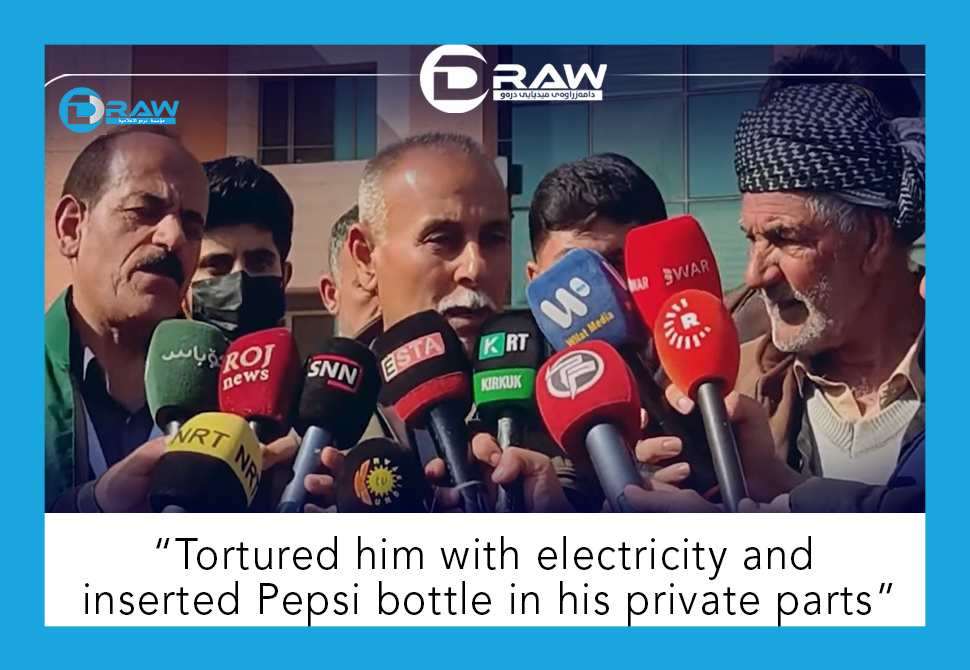
“Tortured him with electricity and inserted Pepsi bottle in his private parts”

Draw Media "Human Rights Organizations and Human Rights Commission in Parliament are silent" They tortured my son for three nights and three days. “tortured him with electricity, and they inserted Pepsi bottle in his private parts”, Mohammed's father told the media in front of the Erbil court. Mohammed's father said, “My son was sentenced to two years and six months in prison on suspicion of joining ISIS.” He added that, "My son is not a Muslim, has never prayed in his life. I will not go to the mosque myself. We are Marxists.” His brother said: “If you torture a 19-year-old child, for three nights and three days, torture him with electricity, insert bottle in his private parts, break his shoulder, how can he not say that he is Abu Bakr al-Baghdadi? Mohammed's father talked about the beginning of the story and said that one day they went to Malekian resort. Then the security director of Topzawa called and asked him to bring his son to testify. Later they handed him over to the anti-terrorism agency.   The lawyer of the Sentenced prisoners, who is also the father of one of the seven youths sentenced, called the decision of the Erbil court unfair and said there was no evidence, but the judge decided on the basis that they wanted to join ISIS. So far, human rights organizations, the Human Rights Commission, the Human Rights Committee of the Parliament, are silent about how the detainees should be treated in this way.    

Read more

British minister of state meets with a group of Kurdish journalists

The British Secretary of State for Middle East Affairs met with a group of journalists and NGO’S in Erbil to discuss freedom of expression and women's issues. Lord Tariq Ahmed, British Minister of State for Middle East, Africa, South Asia and the United Nations affairs at the British Foreign Office with Mark Bryson Richardson, British Ambassador to Iraq and Rosie Cave, British Consul General in the Kurdistan Region met with representatives of the media (Metro, Darw, Paragraf) and representatives of women journalists, listened to the journalists on the situation of freedom of expression and violations against journalists and women.

Read more

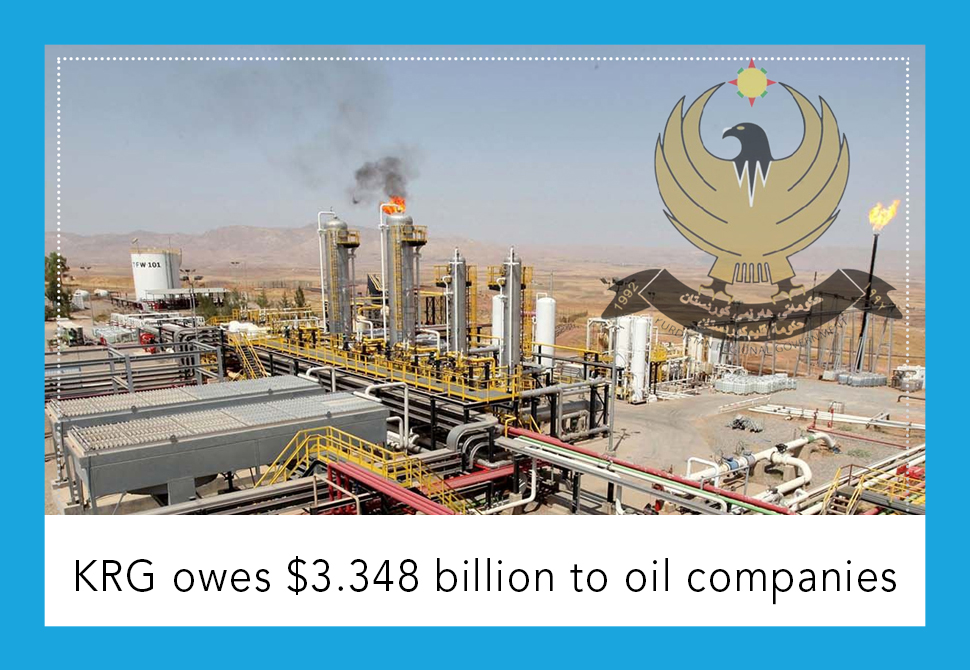
The Kurdistan Regional Government owes $3.348 billion to oil companies

Draw Media In (2022) the Kurdistan Regional Government has paid back $ 1 billion and 115 million to the oil companies, which due to falling oil prices and the coronavirus could not be paid on time. The Kurdistan Regional Government (KRG) has repaid $331.104 million in loans to the companies in the first three months of last year, including $206.4 million to oil producing companies and $125 million to Turkish Companies. In the second quarter of last year, $422.465 million was repaid to oil companies in the Kurdistan Region, while in the third quarter, $194.220 million was repaid. In the last three months of last year, the Kurdistan Regional Government (KRG) has repaid $167 million and 478 thousand debts to oil companies. In addition to repaying the debts of both Turkish energy company and Turkish Petroleum Company The Kurdistan Regional Government (KRG) repaid $990.267 million to the other oil companies last year. Last year, an average of 9 percent of the oil sales were paid back to previous debts of the companies, which currently (KRG) owes $3.348 billion to oil companies.

Read more

The oil values in Iraq and the Kurdistan Region in 2022

Draw Media Based on Deloitte reports, compared to the data of the Iraqi Ministry of Oil and the measures of SOMO, the value of oil in (Iraq and the Kurdistan Region) and the (KRG oil through SOMO) in 2022 is as follows; ? The average cost of a barrel of oil in the Kurdistan Region was more than (45.93) dollars and in Iraq (13.38) dollars, in other words (54%) of the revenue of every barrel of oil went to the cost of the process and in Iraq only (14%) was the cost of the process. ? If the Kurdistan Region had sold oil at the price and cost of SOMO, then instead of (39.06) dollars per barrel, (82.16) dollars would remain, that is, instead of returning 5 billion and 709 million dollars to the government treasury, (11 billion) dollars would return to the government treasury.   First, compare the oil prices of the Kurdistan Region and Iraq in According to the analysis, the Iraqi government in 2022, through the Iraqi Oil Marketing Company (SOMO) sold an average of $ 95.54 per barrel, the total value of oil sold was (115 billion 466 million 245 thousand) dollars. According to Duraid Abdullah, researcher and expert; “Foreign Oil Companies have 20% share out of 70% of the exported Iraq’s oil. "Iraq spent $16.1 billion last year on oil production," he said. According to this analysis, the return rate of Iraqi oil revenue was 86% and 14% went to the cost of oil processing. In other words, an average of $82.16 per barrel of oil sold returned to the Iraqi treasury and $13.38 was spent per barrel. But that is not true for the Kurdistan Region! According to Deloitte, the Kurdistan Regional Government in 2022, through the Kurdistan oil pipeline, sold an average of $ 84.99 per barrel and the total value of oil sold and delivered to foreign buyers (through the pipeline except domestic) was (12 billion 331 million 417 thousand 848) dollars and (90 million 843 thousand 46) dollars from domestic oil sales, but only (5 billion 709 million 704 thousand 87) dollars were put on revenue and the KRG General Treasury (Ministries of Finance and Natural Resources). Accordingly, the return rate of oil revenue was 46% and 54% went to the expenditure of the oil process. In other words, only $39.06 per barrel of oil sold in the Kurdistan region returned to the general treasury and $45.93 was spent per barrel of oil for the production process.

Read more

Draw Media publishes the KRG proposal and the response of the Iraqi Ministry of Oil regarding the oil and gas law

Draw Media According to a document obtained by (Draw Media), the Legal Office of the Iraqi Oil Ministry on 15/2/2023 have responded to the proposals of the Kurdistan Region regarding the oil and gas law and rejects 10 out of 15 suggestions. The proposals have not been directed to the Kurdistan Regional Government (KRG) delegation, but instead the legal office has submitted to the Iraqi Oil Ministry. The Iraqi Oil Ministry is against the KRG (selling oil, having its own oil and gas pipelines, having an oil and gas council, and reviving the KRG's oil and gas law after being repealed by the Federal Court). These are the details of the recent discussions between the Kurdistan Regional Government delegation and the central government on how to write the draft of the oil and gas law. The Kurdistan Regional Government (KRG) has presented its proposal on the law in 15 points. The central government has rejected 10 points of the KRG's proposals, which is 67% of the proposals.   • Article 111 of the Constitution One of the principles that the Kurdistan Regional Government delegation in the negotiations to prepare the draft law on oil and gas submitted to the Iraqi Ministry of Oil, compliance with Article (111) of the Iraqi Constitution. Article 111 of the constitution states that "oil and gas in all regions and provinces belong to the entire Iraqi people." The Iraqi government agrees with the KRG, because it believes that this article of the constitution defines a good basis for the ownership of oil and gas and does not give any rights to either the central government or the KRG. Grant of permission The KRG has proposed that the issuance of oil licenses should be under the authority of the parties specified in the constitution, while the contracts for the fields  in the Kurdistan region should be under the authority of the region, in accordance with Article 115 of the constitution. The federal government rejects the proposal, saying that the constitution does not give the authority to grant oil exploration and extraction licenses to any party, but in Article 112 writes that the federal government together with the Kurdistan Regional Government will manage the oil and gas extracted from existing fields. Transfer of ownership! The KRG has proposed that the oil and gas law allow for the “transfer of ownership of oil and gas to others at the point of delivery”. The central government disagrees with the Kurdistan Regional Government (KRG) on this proposal, saying that such a provision cannot be included in the oil and gas law, because it is contrary to Article 111 of the constitution. The Iraqi government proposes to leave the regulation of the transfer of oil and gas ownership to the sales contracts signed for this purpose.  Oil and gas policy The KRG has proposed that the Federal Council and the Regional Council for Oil and Gas Affairs take over the preparation of the strategic oil and gas policy. The central government opposes the KRG's proposal, saying it is unconstitutional and could open the door to the creation of councils in oil-producing provinces. Oil and gas policy The KRG has proposed that the Federal Council and the Regional Council for Oil and Gas Affairs take over the preparation of the strategic oil and gas policy. The central government is against the KRG's proposal, saying that “This proposal is unconstitutional and could open the door to the creation of councils in oil-producing provinces,". In addition, it will lead to a plurality of stakeholders responsible for setting the overall oil and gas strategy. Who should sell oil? The KRG has proposed that the region have its own marketing company and deposit crude oil revenues into an international account under the control of the region and the revenues from the sale of oil from the federal government into another account. The central government has rejected the proposal, saying it is contrary to the law regulating the Ministry of Oil and the rules of the oil marketing company. "The proposal also contradicts the provisions of the Financial Administration Law and the Federal Budget Law, which state that all revenues from the sale of crude oil must be deposited in an account opened for this purpose.

Read more

Shock survey reflects frustration with ruling parties among Iraqi Kurds

Amwaj Media The story: Rising economic and political dissatisfaction in Iraqi Kurdistan is bolstering an apparent belief that devolved rule under the Kurdistan Democratic Party (KDP) and the Patriotic Union of Kurdistan (PUK) only benefits the ruling elite, rather than the broader population. While this dynamic may not pose an immediate threat to the political dominance of either party, it could undermine the legitimacy and effectiveness of their rule. It is also dangerous for the Kurdistan Regional Government (KRG) in the context of its ongoing disputes with the federal government over the budget, oil, and the disputed areas. The coverage: A new opinion poll conducted by Erbil-based research firm Sheekar Research shows that just over half of respondents believe they’d be better off if the KRG was dissolved and central authority from Baghdad reasserted. •             On its face, the seemingly prevalent sentiment is surprising given the decades-long struggle for Kurdish autonomy in Iraq and the horrors under the previous Baathist regime. It would also be a profound shift from just six years ago, when 92.73% of participants in the Kurdistan region’s 2017 independence referendum cast ballots in favor of seceding from Iraq. •             The survey polled 1,000 people between Jan. 27-28 from across Iraqi Kurdistan using a weighted sample to reflect local demographics. It was conducted using online survey app Prsyar, which randomly selects respondents from a database of 80,000 pre-registered, Kurdish-speaking users to fit a desired sample profile. Respondents were also asked about how they view recent decisions by the federal supreme court against the KRG. Last February, the court ruled that Iraqi Kurdistan’s oil and gas law was unconstitutional, throwing its contracts with international oil companies into legal jeopardy. More recently, the top court on Jan. 25 found that budget transfers arranged between former Iraqi premier Mustafa Al-Kadhimi (2020-22) and KRG Prime Minister Masrour Barzani were illegal. •             A plurality of survey respondents (46%) saw the court’s decisions as “illegal” and “issued against” Iraqi Kurdistan. Yet, most respondents either supported (10%) or felt neutral (42%) about the rulings because they felt the court was primarily punishing the KDP and the PUK. •             The survey also asked about who is to blame for the KRG’s apparent weakness in Baghdad. A fifth of respondents (21%) said the KDP and the PUK were responsible, while a further 47% blamed all Kurdish parties—including the ruling duopoly and opposition groups. One-third of respondents were unsure. The survey results were published by independent outlet Draw Media and then picked up by social media accounts, sparking fierce discussion online. •             Kurdish nationalists denounced the opinion poll with one KRG official pointing to the result of the 2017 independence referendum as a counterpoint. The context/analysis: While the sentiments against devolved rule have shocked many observers, they mainly appear to reflect intense popular frustration with the governance of the KDP and the PUK. Such attitudes should therefore be read as a clear call for improved devolved governance, rather than pro-Baghdad sentiment. •             The KDP and the PUK have governed Iraqi Kurdistan since 1992. Though the semi-autonomous zone is generally more developed than much of the rest of Iraq, wealth is concentrated in the hands of a small elite connected with the ruling parties. •             Since 2014, Iraqi Kurdistan has faced significant economic upheaval caused by periods of low oil prices, the war against the Islamic State group (IS), and budget disputes with Baghdad. Austerity measures have involved cuts to public sector salaries, which the KRG occasionally fails to pay on time. Corruption and lack of investment have furthermore inhibited the development of the private sector. •             According to Sheekar Research, its respondents include a high proportion of government workers, reflecting the public sector’s outsized importance in the economy. Concerns about whether the KRG can pay salaries and a view that Baghdad is more reliable in this regard have likely been reflected in the poll results. Public frustration with the Kurdish ruling parties runs deep, driven by growing economic inequality, poor access to public services, and lack of opportunities to register dissent. •             The KDP and the PUK are increasingly restricting freedom of expression and cracking down on the ability of residents to organize protests. •             Planned elections for the regional parliament last year were scrapped after the KDP and the PUK were unable to agree on a new electoral law. It is unclear whether they will be able to pass legislation in time for the delayed polls to be held in the autumn. •             Iraqi Kurds continue to migrate to Europe at high levels, despite the dangers inherent in that journey. Of further note, public opinion surveys are rare in Iraqi Kurdistan. Narratives about events are often shaped by elite actors to suit their own purposes and spread by partisan media outlets. As a result, seemingly unvarnished public opinion data can come as a surprise to observers, making it all the more valuable. The future: Within Iraqi Kurdistan, the political dominance of the KDP and the PUK remains unchallenged, but public opinion appears to become hard set against the duopoly. This trajectory will likely become intensified by continued economic difficulties. •             The seemingly fading support for the status quo could prove fertile ground for new political opposition factions or social movements, including Islamist groups. •             Rising public discontent could also hamper the ruling Kurdish parties’ ability to rally support for the KRG amid a drive by some players in Baghdad to centralize power through court decisions. Continued squabbling between the KDP and the PUK amid underwhelming governance could additionally impact support for Iraqi Kurdistan by foreign partners, which has been important to its development and economic well-being.  

Read more

Iraqi Kurdistan Suspends Oil Exports Through Turkey After earthquake

The KRG said it was suspending oil exports through Turkey as a precaution after a deadly earthquake rocked its northern neighbor and Syria before dawn on Monday. "Due to the earthquake that hit Turkey and Syria, and to ensure the safety of oil exports and prevent any undesirable incidents, oil exports through the pipeline connecting the Kurdistan region to Turkey have been suspended," the Kurdish ministry of natural resources said in a statement. The Kurdistan regional government usually exports around 450,000 barrels of oil a day through Turkey. It has continued to pump oil out of the country despite the federal authorities demanding a halt to the trade. "The Kurdistan Regional Government confirms the halt of oil exportation through Turkey's Ceyhan due to the earthquake that struck several areas in the country," tweeted Lawk Ghafuri, head of foreign media relations in Kurdistan. "The exportation will resume after careful inspection of the pipelines finalised." A 7.8-magnitude earthquake hit southern Turkey and neighbouring Syria on Monday, killing more than 1,000 people and causing widespread damage, with tremors felt as far away as Egypt and Iraq.  

Read more

KRG oil revenues in December

The Kurdistan Region exported 11 million 825 thousand barrels of oil in December, selling at an average price of $70 per barrel, earning $832 million 953 thousand. Of which $466 million for expenditure and $366 million remained for the government treasury. notice; The exchange rate of the US dollar against the Iraqi Dinar was 1,450 Dinars, according to the Central Bank of Iraq. Non-oil revenues • Non-oil revenues for December = (287 billion) dinars (according to the latest statements of the Minister of Finance) • Coalition assistance to the Peshmerga forces = (31 billion 500 million) dinars • Kurdistan Region's share of the Iraqi budget = (0) dinars Oil revenues (pipeline exports) • In December 2022, the Kurdistan Region exported 11 million 825 thousand barrels of oil. • The average price of Brent oil for December was $82.44 • Because the Kurdistan Region sells its oil at $12 less, it has sold an average of $70.44 (although the value of the Kurdistan Region's oil is said to be about $20 less, but not officially or by Deloitte). So: (11 million 825 thousand) barrels X ($70.44) = (832 million 953 thousand) dollars. That is, in dinars, it is: (832 million 953 thousand) dollars X (1450) dinars = (1 trillion 207 billion 781 million 850 thousand) dinars. • According to the latest Deloitte report, 56% of oil revenues are spent and 44% remains for the Ministry of Natural Resources. - So: (832 million 953 thousand) dollars X (56%) = (466 million 453 thousand 680) dollars goes to the cost of oil processing. - (832 million 953 thousand) dollars X (44%) = (366 million 499 thousand 320) dollars remaining. Oil revenue in dinars is: (366 million 499 thousand 320) dollars X (1450) dinars = (531 billion 424 million 14 thousand) dinars. Total Revenue in December 2022 (Dinar) (531 billion 424 million 14 thousand) oil revenue + (287 billion) domestic revenue + (31 billion 500 million) allies = (849 billion 924 million 14 thousand) dinars

Read more

The Kurdistan Region makes $38 and Iraq makes $82 in a barrel of oil

Oil values in Iraq and the Kurdistan Region in 2022 ? The average cost of a barrel of oil in the Kurdistan Region was more than (49) dollars and in Iraq (13.38) dollars, in other words (56%) of the oil revenue in Kurdistan went to the cost of the production process. ? If the Kurdistan Region had sold oil at the price and cost of SOMO, then instead of $38.6, would have $82.16 left. Which means the KRG’s total net revenue would be $11 billion instead of $5 billion. Comparison of oil values in Kurdistan Region and Iraq in (2022) According to the analyses, the Iraqi government in 2022, through the Iraqi Oil Marketing Company (SOMO) sold oil for $95.54 per barrel on average. the total value of oil sold was (115 billion 466 million 245 thousand) dollars. According to Duraid Abdullah, researcher and expert; “Foreign oil companies have 20% share out of 70% of Iraq's oil exports." According to this information last year, Iraq have spent $16.1 billion for the oil production process. In other words, an average of $82.16 per barrel of oil sold returned to the Iraqi treasury and $13.38 was spent per barrel. But this is not true for the Kurdistan Region! Because according to analyses, the Kurdistan Regional Government in 2022, through the Kurdistan oil pipeline, on average sold oil for $87.58 per barrel. The value of oil sold was (12 billion 784 million 353 thousand 956) dollars, but the amount of (5 billion 625 million 115 thousand 741) dollars returned to the general treasury of the Kurdistan Regional Government. Accordingly, the return rate of oil revenue was 44% and 56% went to the expenditure of the oil process. In other words, only $38.65 per barrel of oil sold in the region returned to the general treasury and $49.2 per barrel was spent.

Read more

Trafigura Ends Oil Deal with Kurdistan After Snub at Davos

•             Trader was owed about $273 million under prepayment contract •             Firm tried to renegotiate deal but Kurdish PM canceled meeting By Jack Farchy Commodities trading giant Trafigura Group is ending a relationship with the government of Kurdistan in northern Iraq, a fresh blow to the region’s ability to sell its oil independently. The parting of ways comes after Trafigura failed to renegotiate the terms of its contract with the Kurdistan Regional Government following a drop in the price of Kurdish oil, according to a person familiar with the matter. After the Kurdistan government refused to renegotiate, Trafigura pinned its hopes on talks with Prime Minister Masrour Barzani in Davos, but a planned meeting last week was canceled by the Kurdish leader at the last minute without explanation, the person said, asking not to be named as the matter wasn’t public. Trafigura was one of several trading houses that, starting in 2014-15, lent billions of dollars to the cash-strapped government of Kurdistan in exchange for future oil sales, in the process helping to finance its bid for independence. Oil is the lifeblood of Kurdistan’s economy, accounting for more than half the government’s revenues, and the exports through Turkey have underpinned its autonomy from Baghdad. For the traders, the deals with cash-strapped Kurdistan represented a potentially lucrative opportunity to secure new flows of oil. But selling Kurdish oil has become more difficult in the past year as Baghdad — which disputes the autonomous region’s right to sell its oil independently — has stepped up legal threats against buyers at the same time as a flood of discounted Russian oil has weighed on prices. “After working together successfully over a number of years, the KRG and Trafigura are amicably parting ways, bringing to an end their long-term contractual arrangements,” the two sides said in a joint statement emailed by a Trafigura spokesperson. After the Davos snub, Trafigura had been preparing to send an acceleration notice to the Kurdistan government, demanding immediate repayment of the money it was owed, the person said. As of last week, the trading house was owed some $273 million in prepayments it had made for future oil flows. Baghdad has long protested Kurdistan’s oil sales, but it has stepped up a campaign against them in the past year in the wake of an Iraqi court ruling in February that found the federal oil ministry should have oversight of Kurdish production. In August, Iraq’s state-run oil marketing company SOMO sent a letter to traders warning them of legal action if they bought Kurdish oil without Baghdad’s approval. Kurdistan’s oil exports of about 400,000 barrels a day are a small fraction of Baghdad’s sales of more than 3 million barrels. There’s evidence that Baghdad’s threats had an impact. Tanker tracking data monitored by Bloomberg show that shipments of Kurdish crude to ports in Spain, Greece and Italy dropped sharply from the middle of 2022, with flows increasing to Israel, Croatia and China in the second half of the year and into the start of 2023. The Kurdistan government owed a total of $3.5 billion to oil buyers at the end of June last year, according to its latest audited oil accounts. Meanwhile, $620 million of oil revenues were stuck in bank accounts in Lebanon as a result of the country’s financial crisis, according to the accounts. The importance of the Lebanese accounts for Kurdistan’s oil wealth became public thanks to a legal battle between a company controlled by veteran trader Murtaza Lakhani and Lebanon’s BankMed SAL. Read more: Billion Dollar Broker: How One Man Managed a Nation’s Oil Wealth The Kurdistan government has itself been seeking to renegotiate the prices it pays to oil producers in the region. ShaMaran Petroleum Corp. announced in October that its Kurdish unit had agreed to change the benchmark against which its crude was priced from Dated Brent to Kurdistan Blend, known as KBT. Separately, another producer said the change amounted to a $10-a-barrel reduction in prices for September. Still, not all oil producers in Kurdistan have agreed to a change. DNO ASA’s managing director said in November that it was “not at this time engaged in active discussions” with the Kurdistan government about a change to the pricing formula. Genel Energy Plc’s chief financial officer told investors last week it “had not accepted any change in pricing mechanism.” In Davos last week, Barzani was focused on shoring up political support for Erbil as well as attracting new investment. He met with the prime ministers of the Netherlands and Belgium, as well as former British prime minister Tony Blair, among others, according to the Kurdistan government’s website.  

Read more

Uncertainty hangs over Iraqi Kurdistan in 2023

BY HAMZEH HADAD In his recent visit to Iraq, the White House coordinator for the Middle East and North Africa, Brett McGurk, focused much of his attention on Iraqi Kurdistan. This region has been a relatively stable part of Iraq, post-2003, but now faces a heightened risk of internal fragmentation and external threat. Frequent foreign attacks undermine prospects for stabilizing Iraq two decades after the U.S. invasion. The formation of a consensus Iraqi government in October, which includes both major Kurdish parties, presents an opportunity to resolve internal Kurdish issues, as well as outstanding ones with Baghdad, but this can be done only with American support. Ensuring stability in Iraqi Kurdistan is important for the U.S. and its allies. The region plays host to coalition troops and various international organizations serving Iraq and Syria. Moreover, previous instances of instability in Iraqi Kurdistan, such as the financial crisis in 2020, triggered major refugee flows into Europe. For many years, NATO member Turkey has had military bases in Iraq to fight the Kurdistan Workers Party (PKK), which both Ankara and Washington view as a terrorist group. Turkish airstrikes and skirmishes have killed many Turkish and PKK fighters, as well as Iraqi civilians. In late July, public anger with Turkey peaked when a Turkish airstrike hit a park in Duhok governorate, killing at least eight civilians and wounding more than 20, many of whom were tourists from central and southern Iraq. These operations also have displaced many families, most notably indigenous minorities such as Yazidis and Assyrians. Turkey claims to have official approval to operate, but Iraq’s Ministry of Foreign Affairs has denounced these attacks. It is believed that the Kurdistan Regional Government (KRG) has allowed these operations to take place in defiance of Baghdad. Turkish airstrikes have continued in 2023 — the latest attack took place on Jan. 9 in Duhok. Prime Minister Mohammed al-Sudani has called for greater cooperation to guard Iraq’s borders and has begun including the chief of staff of the Peshmerga, the Kurdish security forces, in National Security Council meetings in Baghdad. In addition, Iran has claimed responsibility for attacking Iranian-Kurdish opposition groups based in Iraqi Kurdistan. This happened in response to the protests in Iran over the killing of Jina “Mahsa” Amini. Iranian authorities attempted to distract and rally citizens around the flag by attacking “separatist” groups and blaming them for recent unrest. Attacks in September killed a pregnant woman in the town of Koye, and ballistic missiles were launched in November, targeting more Iranian-Kurdish opposition groups. In March, Erbil was hit with 12 ballistic missiles but Iran claimed to target Israeli intelligence presence. Iran and Turkey appear to have taken military matters into their own hands, claiming Iraq is incapable of handling the opposition groups that have taken refuge in Iraqi Kurdistan. The past two decades have witnessed a breakdown in Iraqi security capacity in the face of civil war and terrorism. The Iraqi state has been weakened militarily over the years and the training it received from the Global Coalition is focused only on countering ISIS and not on bolstering overall military capabilities. The security set up with the KRG means that Iraqi Security Forces (ISF) have no presence there, despite border security being an important federal matter. The United States has condemned attacks by Iran and Turkey but has done little to prevent their recurrence. Moreover, there has been little cooperation between the ISF and Kurdish Peshmerga forces since the defeat of ISIS. It will be difficult to achieve integration between the ISF and the Kurdish Peshmerga, since the Peshmerga operate as two separate forces — one belonging to the Kurdistan Democratic Party (KDP) and the other to the Patriotic Union of Kurdistan (PUK) — despite American military backing premised on the promise of unification. These divisions raise fears of a new civil war, a dangerous development that could spill over into the rest of Iraq. American policymakers need to be wary of the growing division between the KDP and the PUK, which has intensified since the death of former Iraqi President and PUK leader, Jalal Talabani, in 2017. Internal division within the more dominant KDP is also likely to worsen as longtime leader, Masoud Barzani, grows older and more distant from politics. The fight for political dominance between his son, Masrour Barzani, and his nephew, Nechirvan Barzani, may plunge Kurdish politics into further chaos. If a conflict emerges between these potential heirs, it will draw in their allies from the rest of Iraq. Despite Kurdish aspirations to democracy, Iraqi Kurdistan has never held elections on time; the 2022 elections were postponed for one year. Although elections can’t change the dominant political landscape, they can force the two parties to form a government together. A KRG with a renewed legal mandate would enjoy greater legitimacy when dealing with the federal Iraqi government. The Kurdish elections can be held alongside the provincial Iraqi elections in 2023, to save costs and maintain democratic practices. This type of coordination and integration could build trust that leads to the resolution of more sensitive matters, such as border security. Given that Kurdish parties welcome partnership at the federal level, by leading ministries and holding the Iraqi presidency, they should similarly welcome partnership in securing Iraq’s federal borders. Unlike in the past, weak Iraqi borders are hurting the Kurdish region much more than the rest of Iraq. The U.S. should encourage negotiations between Kurdish parties and their counterparts in Baghdad. Recently, the Iranian Foreign Ministry offered to mediate between Baghdad and Iraqi Kurdistan, which undoubtedly would bring Iranian interests to the forefront. Iran’s influence in Iraqi Kurdistan is a concern, especially given that a commemoration of Qassem Suleimani was held in Erbil and Sulaymaniyah and attended by high-level Kurdish officials. Considering this, the U.S. should present itself as an alternate mediator and build upon McGurk’s visit, especially considering American investment in Iraqi democracy.

Read more

The UN representative visited Draw Media

To discuss the elections and freedom of expression, the UN Representative in the Kurdistan Region visited (Draw Media). Ricardo Rodriguez, head of UNAMI office to KR (Kurdistan Region), and Karwan Babakr, Head of UNAMI's Sulaimani Office, visited Darw Office in Sulaimani. The visit was to discuss the issue of elections in the Kurdistan Region and freedom of the press.

Read more

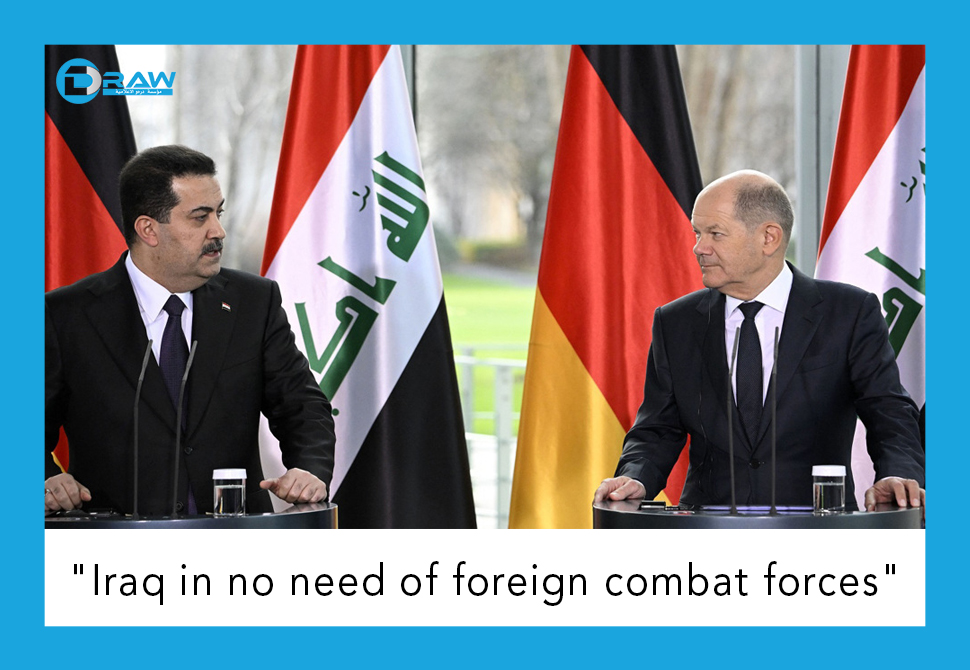
"Iraq in no need of foreign combat forces"

Iraqi Prime Minister Mohammed Shia al-Sudani says his country is in no need of foreign combat forces on its soil as he visits Berlin to discuss bilateral cooperation in various fields. Speaking in a joint press conference with German Chancellor Olaf Scholz on Friday, Sudani said “Iraqi security forces are capable of defeating terrorism.” “Iraq does not need combat forces from the international coalition,” he said. According to the prime minister, Baghdad is reviewing the size and type of remaining advisory forces that remain in the country. Some 2,500 US troops still remain inside the Arab country in what Washington describes as an “advisory” mission. US President Joe Biden and Iraq’s then-Prime Minister Mustafa al-Kadhimi declared in July 2021 that the US mission in Iraq would transition from combat to an “advisory” role by the end of that year. After the 2020 assassination of Abu Mahdi al-Muhandis, the deputy head of the Popular Mobilization Units, along with the region’s legendary anti-terror commander, Iranian Lieutenant General Qassem Soleimani, Iraqi lawmakers ratified a bill that required the government to end the presence of all foreign military forces led by the US.   Iraqi gas export to Germany The German official said they have discussed gas import from Iraq. “We also talked about possible gas deliveries to Germany and agreed to stay in close contact,” he said in the press conference as Berlin is seeking to diversify its energy resources. No further detail on the volume of imported gas from Iraq has been revealed yet. Speaking about the energy ties, Sudani said Iraq wants to help meet global energy needs while also stimulating its domestic economy. He added that Iraq’s gas can be delivered to Europe through Turkey. He said German companies could help Iraqi with the problem of gas flaring. Iraq continues to flare some of the gas extracted alongside crude oil because it lacks the facilities to process it into fuel for local consumption or exports. Opportunities, he maintained, have been offered to German firms to invest in Iraq’s gas industry. Iraq has also signed a deal with German company Siemens to upgrade its power grid. The deal aims to increase Iraq’s power generation by 11 gigawatts. “Iraq is already one of the countries most affected by the climate crisis, and the challenges will continue to grow in the coming years,” Scholz said, adding that Germany wants to help Iraq diversify its economy from fossil fuels and reduce its carbon footprint, including through the use of solar power and hydrogen.

Read more

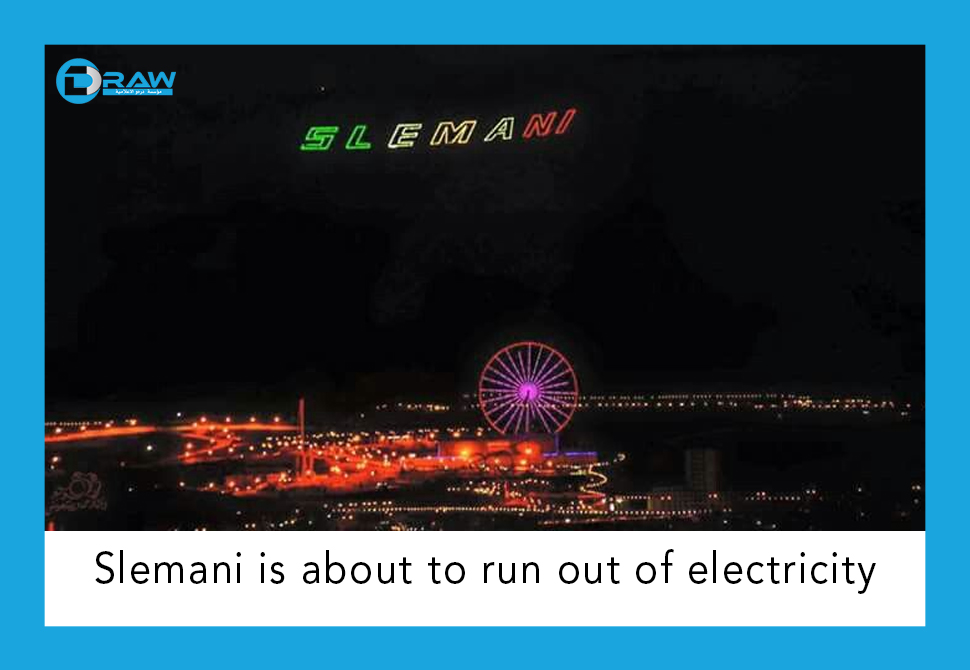
Slemani is going to run out of electricity

On 15/12/1992, Ahmad Bamarne, a member of the first round of the Kurdistan Parliament, wrote to his wife in France: "The situation in Kurdistan is very bad. There is only two or three hours of electricity. Currently, some areas of Sulaimani have only (2) hours of electricity , in (24) hours. When In 1992, three hours of electricity was given to the citizens a day, "The reason is said to be “due to injustice in the distribution of electricity” According to an official statement of the government, the monthly expenditure of electricity is (100) billion dinars, the cost of installing electricity smart meter was (300) billion dinars. About (70) billion dinars monthly expenditure on generator rent which is paid directly by the citizens and the expenditure of the Ministry of Electricity for the generators is (17) billion dinars, but still there is no electricity. From (1992 to 2022) Currently, the electricity is reduced to the lowest distribution level in the Kurdistan Region. Electricity will be provided between 6 to 8 hours in average. However,some areas in Sulaimani have only (2-4) hours of electricity. Experts and electricity officials, attributs the reason to (injustice in the distribution of electricity and ownership of Sulaimani that there is no one to defend).   Demands on electricity According to the official statements of the Ministry of Electricity, currently (3600) MW of electricity is produced in the Kurdistan Region, but the demand for electricity has increased to more than (6600) MW. While the official website of the Ministry of Electricity earlier this month announced that "615 megawatts of electricity has been increased in the ninth cabinet" and power plants are opened daily and talk about increasing the amount of electricity production, but yet the government provides only (7) hours of electricity for the citizens. Smart meters reduce electricity supply! In May this year, a delegation from the Republic of Congo visited the Kurdistan Region of Iraq (KRG) and met with the Minister of Electricity, Kamal Mohammed. At the time, the Ministry of Electricity claimed that the smart meter project had reduced electricity waste from 49% to 39%. Kamal Mohammed is the electricity minister on KDP share in the government. He recently took over another ministry. He was appointed as acting minister of natural resources following the resignation of Kamal Atroshi. There are 1.7 million electricity customers in the Kurdistan Region, of which 1.3 million have installed smart meters, which is 73% of the total number of electricity customers.  Electricity supply has been reduced from 16 hours to 6 hours, contrary to the statements of the Ministry of Electricity, smart meters have reduced the time of electricity supply by 62%, while the cost of installing smart meters was about 300 billion dinars. Electricity income and expenditure There is a huge amount of money is spent on electricity in the Kurdistan Region, so that now more than (100) billion dinars are spent monthly for the companies that produce electricity. In addition to the cost of electricity generation, the total monthly salary expenditure of the Ministry of Electricity (17 billion 850 million dinars), in addition to the money citizens spend monthly to buy electricity from private generators. The number of electricity customers in the Kurdistan Region has increased to 1 million 776 thousand 963. If an average of (4) amps per household of electricity from private generators is calculated and the price of each ampere is calculated at (10,000) dinars, then each family spends an average of (40) thousand dinars monthly to buy electricity from private generators, the average monthly expenditure of citizens to buy electricity from private generators reaches (71 billion) dinars. Accordingly, the total cost of electricity in the Kurdistan Region, including the government's payment and the citizens' payment for generator rent, is more than (200 billion) dinars per month. This expenditure comes at a time when, according to the statistics of the Ministry of Electricity, the monthly electricity revenue is about (50 billion) dinars. Last year, the total electricity revenue was (456 billion) dinars. Currently, the government owes about 1.298 trillion dinars to citizens and the government itself owes the companies $3.883 billion.

Read more

All Contents are reserved by Draw media.
Developed by Smarthand