Draw Media
News / Kurdistan

Fighting for Kurdistan?

Draw Media Netherlands Institute of International Relations-Feike Fliervoet     The Peshmerga forces of Iraqi Kurdistan are a complex and multi-faceted security organisation, their loyalty divided between the Iraqi state, the Kurdistan Regional Government (KRG), different political parties and powerful individuals. At different times – and sometimes simultaneously – they can be characterised as national, regional, party and personal forces. This report explores the dynamics and consequences of these various roles in the broader political context of the relationship between Erbil and Baghdad. For relations within the KRG, as well as between the Kurdish Region of Iraq (KRI) and Baghdad, to develop as constructively and as peacefully as possible, it is important that international partners currently supporting the Peshmerga and/or the Iraqi Security Forces take three recommendations to heart: 1. Develop an integrated security sector reform (SSR) strategy that considers support for the Peshmerga and the Iraqi Security Forces in relation to each other. 2. Ensure that such an integrated SSR strategy is embedded in a broader political strategy for re-including Iraq’s Kurds in the Iraqi polity on favourable, inclusive and reconciliatory terms. 3. Consider the need for reform and reconciliation within the Kurdistan region to prevent further intra-Kurdish conflict.         PDF

Read more

Deductions and non-payment of salaries in the ninth cabinet

Draw Media The total amount of salaries not paid and deducted in the ninth cabinet is; # (6 trillion 300 billion) dinars "7 full salaries" # (1 trillion 701 billion) dinars "9 salaries with 21% deduction" # (162 billion) dinars "1 salary with 18% deduction" # (900 billion) dinars "salary (6) of 2023" delayed # So the total amount of salaries not paid in the ninth cabinet (9 trillion 63 billion) dinars. Arrears and salary deductions as financial entitlements of the region's employees: In the election campaign in Septrmber 2018 political parties campaigned for the return of salary arrears and opening accounts for salaried employees. With the inauguration of the ninth cabinet salaried employees were waiting for the return of their salary arrears, but this cabinet invented a new innovation called (salary deduction). This is despite the fact that in 2020, a record number of non-payment of salaries was recorded. Regarding the financial entitlements of the salaried employees that are the responsibility of the Kurdistan Regional Government, only in the ninth cabinet is more than (9 trillion) dinars. The period of salary arrears was held during the eighth cabinet of the Kurdistan Regional Government (KRG) headed by Nechirvan Barzani. However, in the ninth cabinet, the issue of salaries entered a new stage, which was the invention of salary deductions instead of savings. In this cabinet, the salaries of the months (4, 5, 6, 7, 8, 11, 12 of 2020) were not paid, (9) salaries with a deduction of (21%) and a salary with a deduction of (18%) has been paid to the employees in the years (2021 - 2022). Therefore, if we estimate the total salary expenditure at (900 billion) dinars monthly, then the total financial entitlements of salaried employees in the ninth cabinet has not been paid to them is; • (7) months of salary cuts X (900 billion) dinars = (6 trillion 300 billion) dinars • (9) months with deduction of (21%) X (189 billion) dinars = (1 trillion 701 billion) dinars • (1) month with deduction of (18%) X (162 billion) dinars = (162 billion) dinars • Currently, the month of June (2023) has passed, but the salaries have not been distributed, which is more than (900 billion dinars). Therefore, the total amount of unpaid salaries in the ninth cabinet is; (6 trillion 300 billion) dinars "7 full salaries" + (1 trillion 701 billion) dinars "9 salaries with 21% deduction" + (162 billion) dinars "1 salary with 18% deduction" + (900 billion) dinars salaries  of June 2023 = (9 trillion 63 billion) dinars.

Read more

Masrour Barzani admitts that the KRG had many shortcomings

 Kurdistan Region Prime Minister Masrour Barzani held a meeting with a number of citizens of the Kurdistan Region in Erbil, in which he answered their questions and discussed many outstanding issues with them. During the meeting Masrour Barzani admitted that the KRG had many shortcomings, but he insisted there have been outside forces attempting to sabotage the Region “Some of these crises were created, partly at the local level, or rather by those whose interests were violated or who felt their interests were endangered, and that’s why they oppose our government,” Barzani noted that, “many parties outside the Kurdistan Region tried to put economic, legal and security pressure on this government so that we could not succeed in our tasks. Now I can assure you that many of these crises have passed, but we still have to face some of them with your help.”

Read more

Turkey extends flight ban on Iraqi Kurds' Sulaimaniyah airport over alleged PKK support

Amberin Zaman, Al-monitor Turkey on Monday extended a flight ban to Iraqi Kurdistan’s Sulaimaniyah International Airport for six months, Kurdistan Regional Government (KRG) officials confirmed, in a move that will further squeeze the region’s economy and physically isolate it from the West. The extension was first reported by the Iraqi Kurdish news outlet Rudaw, citing officials from Turkey’s national carrier, Turkish Airlines. The initial ban was announced in April and imposed for three months on the grounds that the airport had become a hub for activities of the outlawed Kurdistan Workers Party (PKK). The Turkish Kurdish group, whose top commanders are based in Iraqi Kurdistan, has been orchestrating its armed campaign against the Turkish military from the Iraq-Iran border since the early 1990s.   Sulaimaniyah is under the control of the Patriotic Union of Kurdistan (PUK), the second most influential party in the Kurdistan Region of Iraq, which has traditionally enjoyed close ties with the PKK. Qubad Talabani, whose older brother Bafel runs the PUK, traveled to Ankara in April in a bid to appease Ankara, but apparently to little effect. The PUK is clearly not living up to Ankara’s expectations to restrict and provide actionable intelligence on the PKK’s activities in the Sulaimaniyah region. The Kurdistan Democratic Party (KDP), which leads the KRG, is, on the other hand, closely allied with Turkey and supports its ongoing military campaign against the PKK. Thousands of Turkish troops are deployed across KDP-held territory close to the Turkish border where the bulk of the rebels are based. Officials of the Syrian Democratic Forces (SDF) are not permitted to use the Erbil airport to travel abroad in keeping with Ankara’s wishes. KRG Prime Minister Masrour Barzani, whose father, Massoud, leads the KDP, became the first foreign dignitary to pay Turkish President Recep Tayyip Erdogan a formal visit following his election victory in May. Ankara insists that the Sulaimaniyah airport has been used to smuggle in weapons destined for the rebels, who used it to travel between Iraq and the outside world. The airport was also used by officials from the US-backed Kurdish administration in northeast Syria, notably Mazlum Kobane, commander in chief of the SDF. The Kurdish-led force is the United States’ main ally in the ongoing campaign to degrade and destroy the Islamic State in northeast Syria. Turkey says that the SDF is part of the broader PKK network and is demanding that the United States scotch its partnership with the group. In April, Turkey targeted Kobane and his convoy, which was also carrying US military officials, near the Sulaimaniyah airport in a drone strike just days after sealing its airspace to flights bound to and from there. Kobane had just returned from a trip to the United Arab Emirates to lobby for its support, as first reported by Al-Monitor. Kobane has kept a low profile ever since, and security measures in northeast Syria have been tightened dramatically. Yet Turkey continues to pick off SDF and PKK-linked individuals in drone strikes both in Iraq and Syria. PKK-led groups are under stronger pressure than ever before, said a Western analyst who spoke anonymously to Al-Monitor following a recent trip to northeast Syria. Bilal Wahab, a senior fellow at the Washington Institute for Near East Policy, views the continued ban as part of a broader trend whereby regional powers Turkey and Iran as well as the central government in Baghdad are engaging the PUK and KDP as individual actors rather than as representatives of a unified KRG — a trend that has been accelerated by the sharp divisions between the Iraqi Kurdish parties themselves. “The KRG as a unified governing entity is being undone. Part of it stems from the KDP-PUK divisions, which are inviting regional powers to deal with the PUK and the KDP separately,” Wahab told Al-Monitor. As such, the flight ban is a further example of Turkey having a KDP and a PUK policy, where one is punished and the other rewarded. “This also tracks with how Baghdad treats the KRG,” Wahab added. Despite its close ties to the KDP, Turkey has failed to allow the resumption of Iraqi and Kurdish oil sales through a pipeline network that runs from KDP controlled territory to export terminals on its Mediterranean coast. Turkey sealed the line on March 25 after an international arbitration court ordered Turkey to pay Baghdad $1.5 billion in damages for enabling the KRG to sell its oil independently of Baghdad. The closure is costing the KRG an estimated $1 billion in monthly revenues that is used to pay 80% of public sector salaries. Turkey is holding out in a bid to pressure Baghdad to drop a separate arbitration case.    

Read more

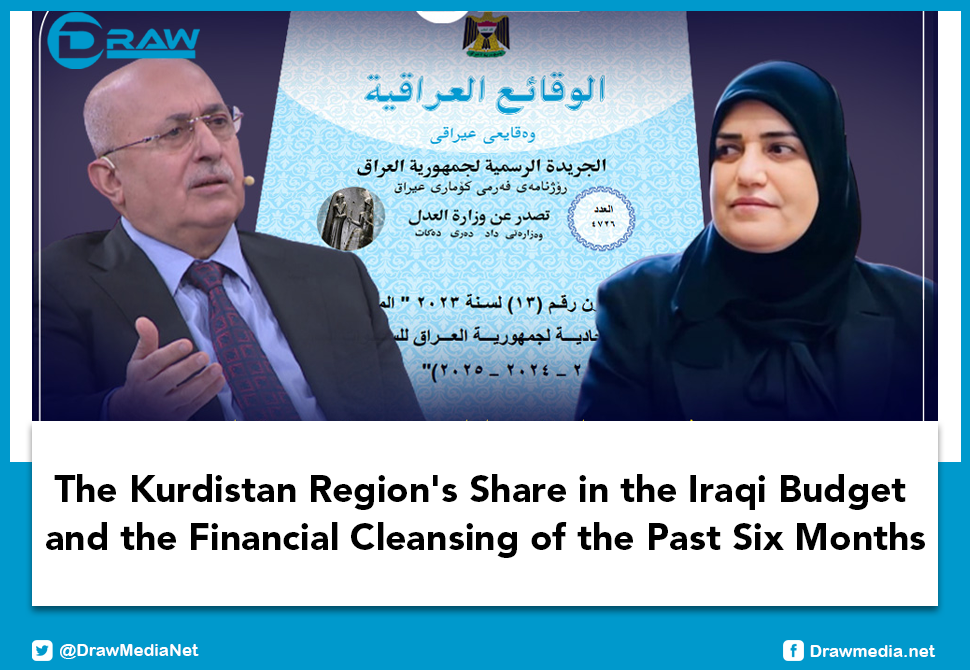
The Kurdistan Region's Share in the Iraqi Budget and the Financial Cleansing of the Past Six Months

Draw Media A delegation from the Kurdistan Regional Government (KRG) is scheduled to go to Baghdad to discuss how to send the Kurdistan Region's share of the Iraqi budget law and the financial cleansing of the past six months of revenues with the Iraqi Ministry of Finance. The Kurdistan Region's financial entitlements for salaries are about (906) billion dinars monthly and (5 trillion 436 billion) dinars annually, in addition to the provincial development budget and other expenditures. For the financial cleansing of the past six months, the Kurdistan Region must return (oil for the first three months of 2023, 50% of the revenue from border points, commercial bank loans, 400 billion dinars loan) to Baghdad. The budget law came into force after it was published in the Waqaii newspaper, because the budget law has (retroactive effect) so it will be counted from January 1, 2023. The delegation of the Ministry of Finance visited Baghdad before the Eid al-Adha holidays, in order to discuss the details of the implementation of the budget law and the share of the past six months.  Finally, the budget law was approved by the Iraqi parliament and published in the Waaqii newspaper, and went into effect immediately. Articles 11, 12 and 13 of the budget law are specific to the Kurdistan Region, in addition to several other items in the budget. According to the budget law: • In the event of payment of 100% of the financial entitlements of the Kurdistan Region as stated in the budget law, the average entitlements of the Kurdistan Region in the budget will be (18 trillion and 310 billion) dinars, that is, (1 trillion and 526 billion) dinars monthly. • In return for receiving this financial entitlement, the Kurdistan Region will bear financial obligation and must return (1 trillion 210 billion) dinars monthly to Baghdadi according to the budget law. According to this equation, the Kurdistan Region will receive 1.526 trillion dinars from Baghdad and return 1.210 trillion dinars to Baghdad, which means each month 310 billion dinars remain for the Kurdistan Region.

Read more

Turkey Has Extended the Suspension of Flights to Sulaymaniyah Airport for Another Six Months

Draw Media Turkey has extended the suspension of flights to Sulaymaniyah International Airport until next year. On April 3, Turkey suspended flights to Sulaimani International Airport, which was supposed to continue until July, but today the Turkish authorities extended the suspension of flights to Sulaimani Airport until December 3 next year, for another six months. The extension of the suspension of flights to Sulaimani Airport comes after the recent visit of Prime Minister Masrour Barzani to Ankara. Turkish authorities say the suspension of flights at Sulaymaniyah airport is to express concern about the increased movement of the Kurdistan Workers' Party (PKK) in Sulaymaniyah province. On April 7, after three days of suspension of flights to Sulaymaniyah, a Turkish drone fired a missile at an area near the Sulaymaniyah airport cargo as Mazlum Kobane, the commander of the Syrian Democratic Forces, was in the airport to return to Syria.The attack caused no damage, It was only to send a message that Turkey is aware of Kobane's visit to Sulaymaniyah. Turkish drones have occasionally targeted PKK officials in Sulaimaniyah province. After the suspension of flights to Sulaimani Airport, Kurdistan Regional Government (KRG) Deputy Prime Minister Gubad Talabani has arrived in Turkey for talks with Turkish officials, but apparently his visit did not affect the Turkish authorities to resume flights to Sulaymaniyah airport.

Read more

The fifth term of Parliament will retire itself

Draw Media The fifth term of the Kurdistan parliament retired yesterday. Only seven MPs have refused to receive their pensions and the six MPs who sworn-in after the extension of parliament, will not be covered by the pension. However, from the next Kurdistan parliament, those who do not meet the legal requirements will not be retired. Contrary to the decision of the Federal Court, the parliamentary office has sent MPs name to retirement since June 30. If a legal complaint is filed, MPs will retire from November 6, and their salaries for the past eight months will also be deducted. More details in this report; Kurdista Parliament began the process of retirement of the fifth term of parliamentarians yesterday. Out of 111 MPs the office of parliament sent the retirement letters of 104 MPs to the General Directorate of Pensions in the Ministry of Finance. According to the investigations of (Draw Media), the office of the Kurdistan Parliament has determined June 30 as the last working day of the parliament. This means that MPs will receive their full salary as MPs for the month of June, which has not yet been distributed. The parliamentary office has sent the names of the parliamentarians to the pension directorate in two lists: • The first list consists of (104) members of parliament. • The second list includes the names of seven MPs, five of whom are from the Islamic Union faction and have been retired since March 1 this year. The other two MPs, Ali Hama Saleh and Shayan Askari, have refused to receive their pensions. Who have refused to retire? The reform law passed by the Kurdistan Parliament on December 16, 2020, includes a provision that states: "A member of parliament voluntarily has the right to waive his rights and pension entitlements," Out of the 111 members of the Kurdistan Parliament, only seven members have refused to receive their pensions. • Ali Hama Saleh • Shayan Askari • Shirin Amin • Kazim Farooq • Mujda Mahmoud • Kawa Abdulqadir • Sipan Amedi

Read more

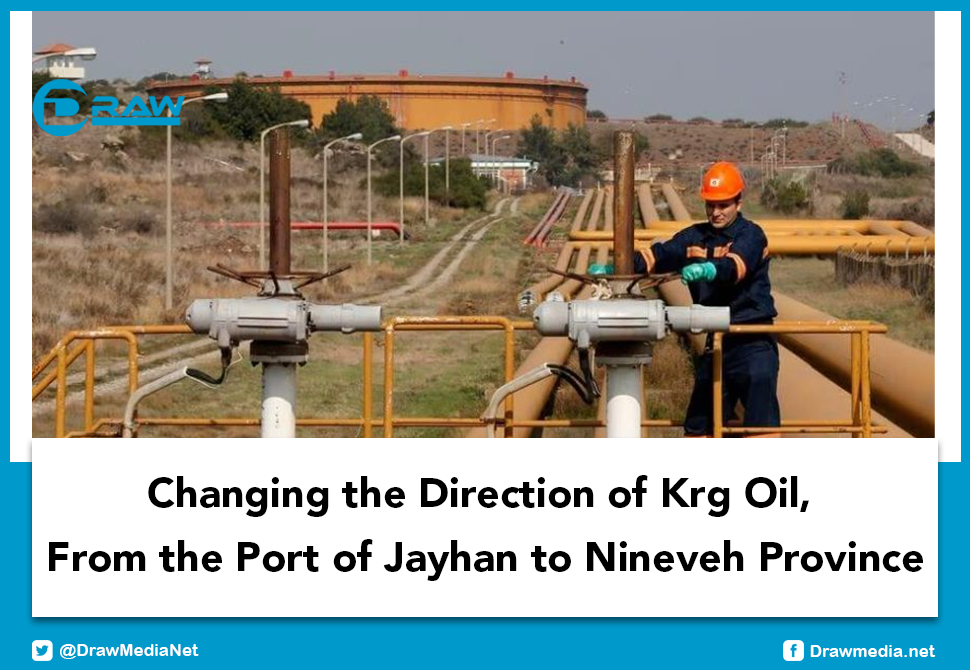
Changing the Direction of Krg Oil, From the Port of Jayhan to Nineveh Province

In the first step after the publication of the budget law in the Iraqi newspaper Waqi'i, the Iraqi Oil Ministry suspended oil exports from Kirkuk to the (Kar) refinery in Erbil. Instead of Kirkuk oil, The Khurmala field, which is under the control of the Kurdistan Regional Government, will meet the needs of oil products in Nineveh province. An informed source in Baghdad told (Draw Media) that the Iraqi Oil Ministry has ordered the suspension of Kirkuk oil exports to Kar refinery and Northern Oil Company immediately implemented the decision and suspended 60,000 barrels of oil per day. After the start of the war against ISIS and the shutdown of the Beji refinery near Tikrit in 2014, the export of oil products to Kirkuk and Mosul has been suspended. To solve the problem, The Iraqi government has decided to provide 100,000 barrels of Kirkuk oil per day to the two refineries (Kar) in Erbil and Qaywan refinery in Sulaimani, to meet the needs of oil products in Kirkuk and Mosul. According to the contract signed by the Iraqi government with the two companies (Kar) and (Qaywan), these two companies will refine each barrel of oil at the amount of (8) dollars, which means that in the past afew years, Kar refinery has earned about (15 million) dollars monthly, and Qaywan refinery about (10 million) dollars. The Kar refinery is close to the Kurdistan Democratic Party (KDP) and the Qaywan refinery is a partnership between Qaywan Company and the PUK General Administration. According to the 2023 Iraqi budget law, the Kurdistan Regional Government (KRG) must deliver 400,000 barrels of oil daily to the Iraqi Oil Ministry through SOMO.  The budget law says that if the Kurdistan Regional Government cannot export oil, the KRG must hand over the same amount of oil to the Iraqi Oil Ministry for domestic use.  

Read more

Will the Kurdistan region revive the 1992 commission?

Draw Media With less than five months to go before the Kurdistan Region's sixth parliamentary elections, there is no prospect of holding elections this year. There is a proposal to entrust the Kurdistan Election Commission to judges like the 1992 commission. However, the proposal will conflict with the Iraqi Federal Supreme Court's decision to dissolve the Kurdistan parliament.  In this situation, the Kurdistan Region has no choice but to wait for the Iraqi Election Commission, which will expire in January next year.  Dissolution of parliament and the issue of elections Political parties are preparing for the Iraqi provincial council elections, which will not include the provinces of the Kurdistan Region and will be held in the disputed areas. The deadline set by President Nechirvan Barzani for the parliamentary elections is still in place and has not been postponed, November 18 this year. On May 30, the Iraqi Federal Supreme Court ruled on the complaints were filed against the extension of parliament and decided to cancel the extension, which canceled all laws and decisions issued after the extension of parliament, especially the May 22 session to re-activate the Election and Referendum Commission. Since the Federal Court's decision, the parliament has not held any meetings, so the issue of holding elections has returned to the Kurdistan region presidency. On November 8, the Kurdistan Region Presidency sent a delegation to Baghdad to talk with the Iraqi Election Commission about preparations for the elections in Kurdistan. This was a recognition of the Federal Court's decision to dissolve the Kurdistan Parliament and the inactivity of the Kurdistan Commission. The Kurdistan region presidency wants to hold elections this year anyway, but this is only as an attempt and in reality a weak possibility.

Read more

Lahur Sheikh Jangi announces the People's List for the elections

Draw Media Lahur Sheikh Jangi announces the People's List for the provincial council elections, and submits a draft for a single list of Kurdish parties. According to Draw Media information, Lahur Sheikh Jangi submitted a project to the Kurdish parties for the Iraqi provincial council election, which is scheduled for December 18. In the project that Sheikh Jangi has suggested to the Kurdish parties, he askes for one Kurdish list in the elections in the Kurdish regions outside the Kurdistan Region. So far, the project has been given to (Gorran Movement, Justice Group, and Islamic Union) and is scheduled to be given to other parties, including the PUK and KDP. A source in the Justice Group told (Draw Media) that Lahur Sheikh Jangi's project has been received by his party, which he asks for submitting one single list for the Kurdish candidates and unity of Kurdish parties for the provincial council elections, in areas outside the Kurdistan Region. Lahur Sheikh Jangi is waiting for the response of the political parties to implement his project, he believes that the Kurdish situation in the Kurdish areas outside the Kurdistan Region is very bad and needs a single list and unity of all the Kurdish parties. Draw Media has learned that, If the parties do not agree to his proposal, Lahur Sheikh Jangi will have his list to participate in the Iraqi provincial council elections in Kirkuk and Kurdish areas outside the Kurdistan Region, and Shadman Mullah Hassan, a leader close to Lahur Sheikh Jangi, confirmed Draw Media's information about Lahur Sheikh Jangi's project. The Iraqi provincial council elections are scheduled for December 18, the Kurds will have lists in the provinces of Kirkuk, Nineveh, Salahaddin, and Diyala. However, the Kurdish parties have not yet announced any plans for how the elections will be conducted and how the Kurdish parties will participate. In the provinces located in the Kurdish areas outside the Kurdistan Region, there is competition for 71 provincial council seats among different communities (Kurdish, Arab, Turkmen) in addition to the religious minorities: • For Kirkuk province: 15 seats • For Nineveh province: 26 seats • For Salahaddin province: 15 seats • For Diyala province: 15 seats

Read more

Mullah Halo denies any involvement in the murder of Khwanas Warya "the king of the street"

Draw Media Khwanas Warya Gli, who called himself "The king of the street" was shot dead on Thursday in the center of Chamchamal city. Less than 24 hours later, the Kurdistan Region's local security forces (Asayish) announced that they have arrested the killer of (Khwanas Warya). The killer identified as (Hersh Karim), had previously posted Mullah Halo's speeches on his Facebook account, after he has been arrested, attributed the murder to religious differences.  Mullah Halo Hama Rashid is the leader of an Islamic group who is now accused by activists of encouraging the killing of infidels and those who insult religious beliefs. Mullah Halo, in a recorded video denied any involvement in the murder of Khwanas Warya and stated that he does not know neither the killer nor the murdered, "I never said to kill anyone who is an infidel", he said. Mullah Halo also clarified that there is nothing more than a fruit knife in his house. "I have never prepared myself for any confrontation." (Khwanas Warya), was born in 2001 in Chamchamal. He is married and has a three-year-old child named Ramin. He was an artist and painter. A motorcyclist shot him dead in Chamchamal city center on June 22, 2023. He had returned from the UAE for two days. According to his father, he was working in a garage in UAE.  According to Draw Media information, Khwanas comes from a prominent family in Chamchamal and they belong to the Gli tribe. Khwanas's father, Warya Gli, is one of the prominent novelists and has dozens of novels, such as: (My Grandmother's Bus, She was my uncle, Jessica, my sweet daughter...).  When Maria Sami was killed on March 10, 2022, in Erbil, Khwanas wrote: “There is no crime worth taking away a person's soul and killing her". No one can be killed for wearing a headscarf, smoking, or changing religion. I am proud that I have not turned a blind eye to injustice for a minute.

Read more

"The king of the street" was shot dead in the center of Chamchamal city

Draw Media Khwanas Warya Gli who called himself "The king of the street" was born in 2001 in Chamchamal. He is married and has a three-year-old child named Ramin. He was an artist and painter. A motorcyclist shot him dead in Chamchamal city center yesterday. He had returned from the UAE for two days. According to his father, he was working in a garage in UAE. According to Draw Media information, Khwanas comes from a prominent family in Chamchamal and they belong to Gli tribe. Khwanas's father, Warya Gli, is one of the prominent novelists and has dozens of novels, such as: (My grandmother's bus, she was my Uncle, Jessica.. my sweet daughter...). When Maria Sami was killed on March 10, 2022 in Erbil, Khwanas wrote: “There is no crime worth taking away a person's soul and killing her". No one can be killed for wearing a headscarf, smoking or changing religion. I am proud that I have not turned a blind eye to injustice for a minute.

Read more

How Iraq’s new budget affects oil arrangement with Kurdistan region

By Adam Lucente Iraq’s passage of a federal budget this month could have significant ramifications for the country's oil sector as well as the autonomous Kurdistan region. Iraq’s Council of Representatives, or parliament, passed a record $153 billion budget on June 12. The budget uniquely covers the years 2023 to 2025, includes sizable spending on development and infrastructure projects, and plans to add tens of thousands of public sector jobs. The budget was finally passed after months of political battles, involving tense debates over the oil revenue split between the federal government in Baghdad and the Kurdistan Regional Government (KRG).  For comparison, the 2021 budget amounted to $89 billion. Iraq did not pass a budget amid the political instability of 2022, prompting the government to pass emergency legislation to fund certain provisions. The budget is based on an oil price of $70 per barrel and exports of 3.5 million barrels per day, including 400,000 barrels from the autonomous Kurdistan Region. It allocates 12.6% of federal funding to the KRG, according to reports. Iraqi Prime Minister Mohammed Shia al-Sudani said that his government would review amendments that were made to the budget bill prior to its passage to ensure they conform with the government’s “approved ministerial program,” the official Iraqi News Agency reported on June 12. On Wednesday, Iraqi President Abdul Latif Rashid ratified the budget.  The budget is expected to have important ramifications on the oil sector. For years, the KRG and Baghdad have fought over oil revenue and the region’s independent oil exports to Turkey. Past budget disputes regarding the KRG’s oil sector have led to tensions between Erbil and Baghdad. In 2020, Iraq cut federal budget contributions to the KRG after Erbil failed to turn over the 250,000 barrels per day stipulated in the 2019 budget. The situation escalated in March when Turkey stopped its oil imports from the Kurdistan Region after a ruling by the Paris-based International Chamber of Commerce that said Turkey owed Iraq $1.5 billion for receiving unauthorized exports. In April, the KRG and the Iraqi federal government announced that they reached an agreement whereby Iraq’s state oil company, SOMO, would market the Kurdistan Region’s oil. The regular oil flows of about 450,000 barrels per day from the Kurdistan Region were expected to resume after the April agreement, and Iraq formally asked Turkey to resume the oil flows in May. This has yet to occur, however. Iraqi and Turkish energy officials held talks on Monday, but failed to resolve the issue, Reuters reported. The current budget may lead to more federal control over the KRG’s oil in light of the April agreement. Emily Hawthorne, senior Middle East and North Africa analyst at the US-based risk intelligence firm RANE, said that the oil-for-funding arrangement per the budget is more “codified” as a result, and that the KRG will need to turn over the oil this time. “In general, the budget passage is good for the oil-sharing agreement and the prospects for the oil agreement actually being implemented,” Hawthorne told Al-Monitor. “The KRG really has to hand over the 400,000 barrels a day to SOMO in order to get any of that money from the budget.” Kurdish affairs expert Wladimir van Wilgenburg wrote for S&P Global last week that many Kurds feel the budget "paves the way for Baghdad to take more control over the region's oil exports and budget and could complicate plans to revive shuttered crude production." Wilgenburg also pointed out that the Kurdistan Region is unable to pump the 400,000 barrels per day stipulated in the budget with exports to Turkey stopped. The pricing of oil at $70 a barrel in the budget will determine how well Iraq can fund the government. Oil revenues accounted for 85% of the previous budget, according to The World Bank. The price of Brent crude oil, considered the global benchmark for oil prices, has been above $70 a barrel throughout the year, hitting a low of $71.84 on June 12, according to market data. Hawthorne said that oil prices remaining above $70 a barrel is important for Iraq with regards to the budget. “If oil stays above $70 a barrel, it’s great and they can fund what they want. The problem is if oil goes lower than that, then the deficit goes higher and there is a lot of vulnerability, more debt burden on the Iraqi government,” said Hawthorne.  

Read more

In Iraq, the Kurds Are Their Own Worst Enemy

Draw Media by Yerevan Saeed/washingtoninstitute Kurds were once referred to as kingmakers, a pillar of stability, and the most powerful force in the fight against ISIS. Now, the Kurdish Region of Iraq is crippled by ferocious partisanships, tribal politics, and internal splits. After months of horse trading and wrangling, the Iraqi Parliament approved a contentious three-year budget on June 12. The budget for 2023 secures a record-breaking 153 billion dollars to fund Iraq’s growing public sector, development projects, and infrastructure. Although Kurdish-Arab disagreements over the rights and obligations of the Kurdistan Regional Government (KRG) in the budget stymied parliamentary sessions for a few days, internal Kurdish divisions eventually aided Shia and Sunni factions in weakening the Kurdistan Region's financial independence. This effectively brought the KRG under federal authority, ushering in a new era of Erbil-Baghdad relations. The Kurdish Role in Post-2003 Iraq Since 2003, the Kurdistan Region of Iraq (KRI) has gained a considerable degree of autonomy and political influence within the country. Indeed, the Kurds have been active participants in Iraq's new political landscape since the very beginning, getting heavily involved in the drafting of the new Constitution and ultimately shaping the political system in Iraq. They have held significant positions in the federal government and have been involved in the negotiations for and formations of various governments over the years. The ceremonial Iraqi presidency post has traditionally been reserved for Kurds. Militarily, the Kurdish Peshmerga forces were instrumental in the U.S.-led invasion of Iraq in 2003. As ISIS moved in in 2014, Peshmerga forces actually gained territory and economic resources by extending their control over the oil rich province of Kirkuk after federal Iraqi forces abandoned their posts. The Peshmerga effectively repelled the Islamic State from Kirkuk, and later took part in offensives to drive the extremist group back. They were lauded as the fighting force on behalf of the world.  In addition to dealing with these political and military problems, the KRG has actively developed its economy over the last several years, luring international capital and forming business alliances. It significantly expanded its hydrocarbon industry and exported 450 thousand barrels of oil daily until March 2023. As a result, Kurdish-controlled areas were the most prosperous part of the country. Even despite the recent economic setbacks and the inability of the KRG to pay civil servant salaries—in addition to the wealth disparity underlying the region’s economic development—Kurdistan’s poverty rate remains the lowest across Iraq.  Kurdish Divisions Under the Surface The KRG seems to possess all the characteristics of a sovereign state except for any official international recognition. It even made an attempt to obtain complete sovereignty in 2017 by holding a highly contentious independence referendum. However, this referendum resulted in significant geographical, political, and economic losses and exacerbated the internal rifts hiding under the surface of the KRG’s apparent successes.  Politically, the historic power struggle between the two ruling parties—the Kurdistan Democratic Party (KDP) and the Patriotic Union of Kurdistan (PUK)—has only gotten worse in recent years. Efforts by Western diplomats, including Assistant Secretary of State for Near Eastern Affairs Barbara A. Leaf, to encourage the two parties to restore a functional relationship have only brought temporary relief. As soon as Western guidance is removed, every deal is followed by a significantly more serious dispute between the KDP and the PUK. This reality reveals a harsh truth: internal Kurdish peace is dependent on a determined and consistent foreign whip.  The irony is that Kurds are adept at bringing rival foreign powers together, but awful at handling their own internal differences. Case in point, KRG President Nechirvan Barzani is credited with mediating the phone call between then UAE Crown Prince Mohammed bin Zayed and Turkish President Recep Tayyip Erdoğan, which resulted in the normalization of diplomatic relations between the two nations. Though Barzani, to his credit, has summoned the Kurdish parties and gone the extra mile to try to bridge political gaps within Kurdistan, his initiatives have been impeded by the complete lack of trust introduced by deeply individualized politics. These tribal politics are so bad that each party is hell-bent on bringing the other down, regardless of the consequences for Kurdistan. As a result, the internal divisions have undermined Kurdistan’s autonomy against the federal government. These inter-party conflicts have weakened Kurdish collective bargaining power and have hampered the Kurds’ ability to present a unified front in negotiations with the federal government. Internal schisms have also resulted in a lack of cohesive decision-making, making it impossible for the autonomous region to effectively advocate for its autonomy and assert its budgetary needs. Shia parties in the Coordination Framework used such splits to gain more control and influence over the region's finances, especially in the newly-approved Iraqi budget law. The subservience of Kurdish power did not stop with the loss of Kurdistan's entire oil industry. Every dollar given to Erbil is now subject to rigorous federal audits, and the KRG Prime Minister's authority over how money is spent is now under the jurisdiction of the Iraqi Federal Government and the Federal Board of Supreme Audits. As retaliation for being sidelined by the KDP financially, the PUK faction in Baghdad worked diligently to make the Iraqi Prime Minister the arbitrator in the event of a Kurdish internal fight over financing. It remains to be seen whether the Prime Minister will use his legal right to engage in internal Kurdish affairs.  The Kurdish parties' failure to rise to the occasion has diverted focus and resources away from governance and development, jeopardizing the region's potential to construct strong institutions and efficiently govern itself. It has undermined the KRG’s credibility and standing on national, regional, and international levels. Even throughout the budget debate, which was crucial to the economic viability of the region, the Kurdish parties failed to devise a well-balanced policy. Their finest strategy was to bite their nose in order to spite their face. As a result, the Kurdistan Region is weaker than ever before, and its future is uncertain. The KRG institutions have lost their legitimacy not just in the eyes of the people but also from the legal perspective after the Iraqi supreme court ruled that the extension of the Kurdistan Region’s parliament tenure was unconstitutional.  Now, the Kurdistan region needs to hold an election to restore public and legal legitimacy. In addition, such an election could reset all political tensions and conflicts between the Kurdish political parties. While a fresh election cannot guarantee national unity, it can provide an opportunity to foster trust, encourage dialogue, and increase citizen participation. The election can also help build a sense of unity and shared purpose provided it is fair and clean. For this to happen, the political field in Kurdistan must be leveled through a new political pact backed by the KRG's foreign patrons. This demands more American and European diplomatic engagement than ever before, despite their sense of diplomatic fatigue. In the event of a Western diplomatic vacuum, China and other western adversaries could seek to fill in the gap. Washington must not allow Beijing another diplomatic win in the Middle East.

Read more

Kurdistan Region sells 212 billion dinars worth of oil monthly

Draw Media 122,000 barrels of oil are sold daily in the Kurdistan Region, which will be given to refineries at a price of $40 per barrel and Its monthly revenue is (212) billion dinars. However, this income is unknown and it has not been announced. After the decision of the International Court of Arbitration in Paris and the suspension of oil exports from the Kurdistan Region on March 25, 2023, oil production and sales continue in several oil fields in the Kurdistan Region. According to the investigations of (Draw Media) currently in some oil fields in the Kurdistan Region of Iraq, oil production and sales continue. The Kurdistan Regional Government (KRG) is paying $30 to $35 less than the world price of oil to oil refineries in the Kurdistan Region. Ali Hama Salih, former chairman of the Kurdistan Parliament's Energy and Natural Resources Committee, told Draw Media that, "Some of the oil from the oil fields that is sold domestically, selling for $250 to $300 a ton (that is $40 a barrel) Some of it is given to the official refineries (Lanaz and Kar) and some of it is sold to the unofficial refineries. Yadgar Sadiq Galali, the head of Roonbin Organization for Transparency in Oil Processes, explained the sale of oil in the Kurdistan Region in detail to Draw Media, "48 hours after the halt in oil exports, oil field storages were full", Because the oil storage infrastructure in the Kurdistan Region is very weak, only (Sarsang and Taqtaq) fields have very high storage levels. Taqtaq used to produce 146,000 barrels of oil, but now it produces only 3,610 barrels. • There are (5) refineries in the Kurdistan Region • Two refineries in Sulaimani province (Bazian refinery) has a refining capacity of (40) thousand barrels. Dukan refinery has a production capacity of 25,000 barrels. • There are two refineries in Erbil, Kar refinery has a refining capacity of (170) barrels, Lanaz refinery has a production capacity of (100) thousand barrels of oil. • There is a refinery in Duhok province belonging to DNO with a production level of 6,000 barrels per day. • This means that all five refineries in the Kurdistan Region have the capacity to refine 300,000 barrels of oil per day. Also, a total of 122,000 barrels of oil are sold daily, at a price of about $40 per barrel. That is, the total monthly revenue of the oil (122,000 * 40 * 30 = 146,400,000 dollars, or (212 billion 280 million) dinars. The Kurdistan Regional Government (KRG) has sold some of the oil from the oil fields in the Kurdistan Region for more than 80 days since the March 25, but the revenue has not been declared and paid to the Ministry of Finance.  

Read more

All Contents are reserved by Draw media.
Developed by Smarthand