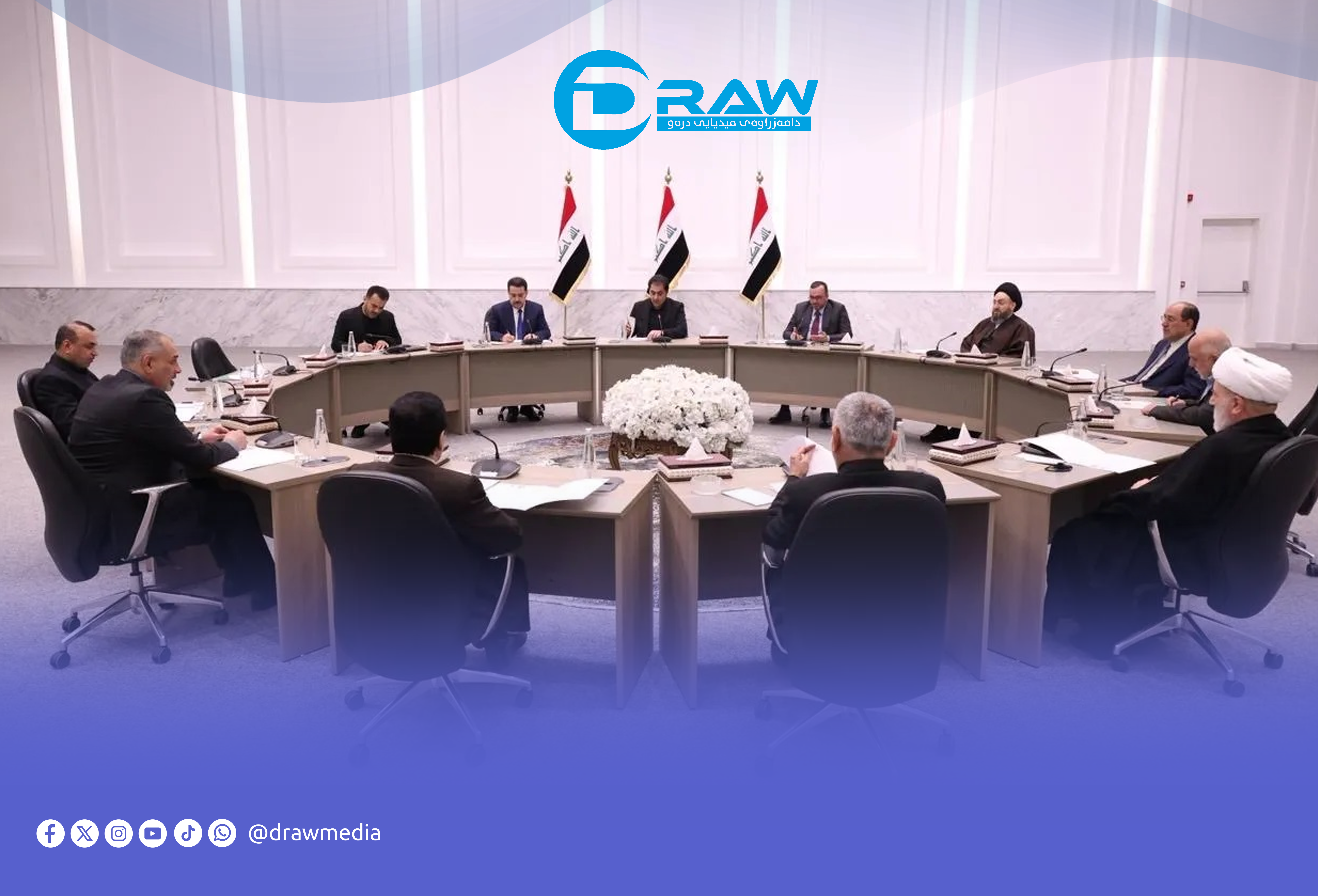
According to sources within the Coordination Framework speaking to Al-Hurra, the competition has now narrowed down to two candidates.
The Coordination Framework, which holds around 187 out of 329 parliamentary seats, has until April 25 to submit its candidate to the president.
Article 76 (First Clause) of Iraq’s 2005 Constitution obliges the president to assign the candidate of the largest parliamentary bloc to form a government within 15 days of the president’s election.
The Coordination Framework has failed to hold any meetings since parliament elected Nizar Amedi as president on April 11. A key meeting scheduled for Wednesday was postponed to today.
A well-informed source responsible for coordinating meetings within the Framework said that an important meeting took place before today’s general session.
According to the source, bilateral and trilateral meetings were held Friday evening among the Framework’s leaders to reach a preliminary agreement before the general meeting.
The Coordination Framework consists of 12 members representing Shiite leaders and factions, whose parliamentary sizes range from 45 to 5 seats. However, the voting mechanism within the Framework is not based on seat numbers; rather, each bloc leader has equal voting weight regardless of size.
A second source stated that it was agreed a candidate who secures two-thirds of the votes (8 out of 12) will become the official nominee for prime minister.
The source added that current Prime Minister Mohammed Shia al-Sudani has the highest chance, holding 6 votes, while his rival Basim Badri has 4 votes.
Two factions remain undecided: one is considering both candidates, while the other is waiting for one candidate to reach seven votes before offering support.
Despite Nouri al-Maliki’s withdrawal from the race due to a U.S. veto and internal opposition, he has not officially announced it. However, the second source confirmed that Maliki insists on backing Badri as his alternative.
Other figures still have slim chances, including:
Hamid al-Shatri, head of the National Intelligence Service
Qasim al-Araji, National Security Advisor
Mohammed Sahib al-Darraji, former Minister of Reconstruction and Housing
Haider al-Abadi, former Prime Minister
The Coordination Framework now faces a critical moment and a difficult dilemma: it must choose a prime minister who does not anger Washington.
The bloc fears backing a candidate who might face the same fate as Maliki, especially after Donald Trump warned last month that “Maliki’s return to power would negatively impact Baghdad–Washington relations.”
A senior source within the Framework said:
“What we are looking for now is a prime minister who enhances relations with Washington, not harms them.”
The source added that political forces are overwhelmed by unprecedented U.S. pressure.
In his remarks, he also noted that Joshua Harris, the U.S. chargé d’affaires, delivered a message emphasizing the need to avoid forming a government that fails to protect diplomatic missions and U.S. interests.
Meanwhile, a source close to Maliki said the situation remains complicated. Maliki has not formally withdrawn, but he will support whoever gains the majority within the Coordination Framework.